

ECOVACS Goat O1000 RTK Review: Real-World Performance, Setup Guide, and Is It Worth It for Your Lawn?
Aaron Cooper
Review: ECOVACS Goat O1000 RTK
Quick Take: A reliable and precise wire-free robot mower that excels in navigation and obstacle avoidance for small-to-medium yards.
Best For: Homeowners with up to 1/4 acre lawns who want to eliminate boundary wires and reduce manual trimming.
Keep in Mind: While it handles slopes well, cutting height must be adjusted manually on the unit rather than through the app.
1. Introduction: Who Is the ECOVACS Goat O1000 RTK Really For?
If you own a small-to-medium yard—up to about 1/4 acre—and you’re tired of spending every weekend behind a mower, the ECOVACS Goat O1000 RTK is clearly aimed at you. It promises wire-free setup, RTK + LiDAR precision navigation, AI-powered obstacle avoidance, and edge mowing that actually reduces trimming.
But here’s the real question: does it truly deliver hands-free, reliable lawn care in real-world conditions—hills, tree cover, narrow paths, and all? In this guide, we’ll break down its core technology, long-term performance insights, setup realities, and overall value so you can decide if it’s the right autonomous mower for your yard.
2. Core Technology Breakdown: RTK + LiDAR Navigation, AIVI 3D, and TruEdge Explained
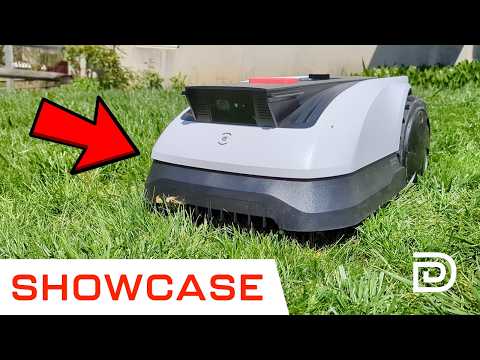
2.1 LiDAR-Enhanced RTK (LELS): 2cm Precision and Stable Signal Even Under Tree Cover
Traditional GPS-only robot mowers can feel like they’re mowing “by approximation.” The Goat O1000 RTK takes a different approach with its LiDAR-Enhanced RTK system (LELS).
RTK (Real-Time Kinematic positioning) is a satellite-based correction system often used in surveying. In simple terms, it dramatically improves positioning accuracy. According to ECOVACS’ official specifications, the system achieves 2cm positioning precision and can receive signals from up to 45 satellites across expanded signal bands. That’s a level of accuracy that allows the mower to track tight edges and maintain clean, consistent passes.
But what really matters is what happens under trees. Shade and canopy cover are where many GPS mowers struggle. The O1000 pairs RTK with 3D-ToF LiDAR and a fisheye camera, which act as backup “eyes” when satellite signals weaken. Independent coverage highlights its 4x faster RTK connection recovery and 30% improved stability in shaded areas, helping reduce random stops in tree-heavy yards.
2.2 AIVI 3D Obstacle Avoidance: How It Detects 200+ Objects and Protects Pets
We’ve all seen robot mowers that bulldoze into toys or get tangled in garden décor. That’s where AIVI 3D comes in.
The Goat O1000 RTK combines AI vision with 3D-ToF LiDAR to identify and avoid over 200+ common garden obstacles, including pets and even small animals like hedgehogs. Instead of simply bumping and redirecting, it analyzes what’s in front of it and adjusts course proactively.
Video demonstrations show it stopping short of objects like flower pots and rerouting instead of colliding. If an obstacle is partially in its path, it can navigate around it; if fully blocking, it reverses direction and continues systematically.
For pet owners, this isn’t just convenience—it’s peace of mind. The mower includes safety features like a lift sensor and emergency stop button, and it operates at a low noise level (around 57 dB), so it’s quiet enough not to stress animals or neighbors.
2.3 TruEdge and U-Shaped Path Planning: Does It Really Eliminate Manual Trimming?
Edge trimming is where many robot mowers fall short. You still end up grabbing a string trimmer and cleaning up messy borders. ECOVACS tackles this with TruEdge and U-shaped path planning.
Using its precise LELS navigation, the Goat follows structured U-shaped mowing lines designed to achieve 100% coverage of the claimed lawn area (under lab-tested conditions). Instead of random bouncing, it mows methodically—horizontal and vertical passes—to reduce missed strips.
TruEdge comes into play along borders. For passable edges like driveways or flat transitions, the mower can straddle the boundary with zero-edge cutting. For unpassable edges—like walls or fences—it gets impressively close using 3D sensing.
While TruEdge significantly reduces trimming, it doesn’t eliminate it entirely. Around utility boxes, very tight corners, or complex landscaping, you may still need a quick touch-up. But compared to traditional robotic mowers? The difference is noticeable.
3. Real-World Performance: Slopes, Narrow Paths, Battery Life, and Long-Term Reliability
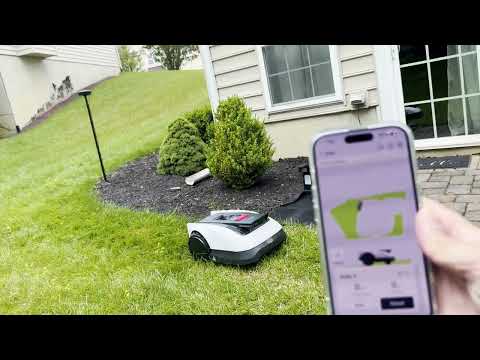
3.1 Slope Handling up to 45% and Narrow Passages Down to 0.7m
The Goat O1000 RTK is rated for 45% (24°) slope capability in working areas, with a 3cm barrier-crossing ability. In practical demonstrations, it successfully climbs steep backyard hills that would typically cause wheel spin or shutdowns in lesser models.
For tight layouts, the mower’s slim profile allows it to pass through paths as narrow as 0.7 meters (2.3 feet). That’s especially useful for side yards or connecting strips between front and back lawns.
3.2 Battery Runtime, Auto-Recharge, and Resume Function
- Runtime: About 65 minutes of mowing per charge.
- Recharge: Approximately 100 minutes for a full charge.
- Auto-Resume: Returns to dock at 15% battery, recharges to 80% in 45 mins, and resumes from breakpoint.
That resume-from-breakpoint behavior is critical. Instead of starting over or leaving unfinished patches, it continues its previous mowing pattern seamlessly. For a yard up to 1/4 acre, this charge cycle strategy is generally sufficient to complete mowing in one or two sessions without manual involvement.
3.3 Blade Durability, Noise Level, and ‘Zero Rescue’ Experiences
Pros
- Extremely quiet operation at 57 dB.
- "Zero rescue" periods reported for weeks of autonomous use.
- Straightforward blade replacement process.
Cons
- Blades require flipping/replacing every 3-6 weeks.
- Razor-style blades are consumable parts requiring ongoing maintenance.
The O1000 uses three small razor-style blades mounted on a rotating disc. Long-term user feedback suggests flipping the blades roughly every three weeks and replacing them around six weeks, depending on mowing frequency and grass type.
4. Setup and Installation: RTK Placement, Wi-Fi Requirements, and Mapping Tips

4.1 Where to Place the RTK Antenna and Charging Station for Best Signal
The promise of “wire-free” is exciting—until you wonder where everything actually goes.
| Component | Placement Requirement |
|---|---|
| RTK Reference Station | Vertical, 6.56 feet away from buildings/trees, clear sky view. |
| Charging Station | Flat turf, 15.75 inches side clearance, 6.56 feet front clearance. |
Wi-Fi strength also matters. While the mower navigates via RTK and LiDAR, the app communication and updates depend on a stable connection at the base location. A weak signal here can create unnecessary frustration during pairing or firmware updates.
4.2 2.4GHz Wi-Fi, PIN Setup, and App Pairing Process
The setup process is surprisingly straightforward—but there are a few technical details to get right.
- Connect your smartphone to a 2.4GHz Wi-Fi network.
- Scan the QR code on the mower via the ECOVACS Home app.
- Set a four-digit PIN directly on the mower’s interface for theft protection.
- Complete any mandatory firmware updates.
From unboxing to mapping, most users report completing setup in roughly 15–30 minutes. Compared to burying perimeter wires for hours, this feels refreshingly modern.
4.3 Auto Mapping vs Manual Mapping: When to Use Each
One of the most impressive features is automatic boundary mapping. Instead of manually driving the mower like a remote-control car, you can let it intelligently detect and trace the perimeter.
However, manual mapping still has its place. Complex zones, steep drop-offs, or intricate landscaping may require you to guide the mower yourself. During manual mapping, you must stay within Bluetooth range (about 6 feet) while walking behind it.
Once mapped, the app allows you to edit zones, merge or split areas, create no-go zones, adjust cutting height (3–8cm range), and even set different mowing speeds per zone.
Check Price on Amazon5. Price-to-Value Analysis: Is the ECOVACS Goat O1000 RTK Worth It?
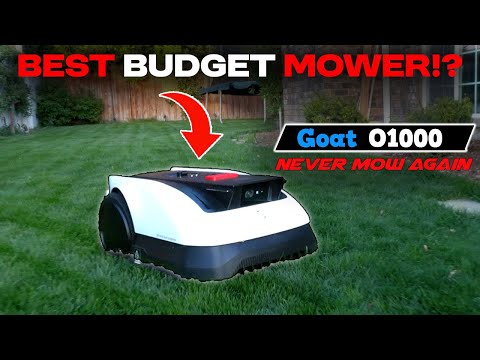
Let’s be honest. No robot mower is “cheap.” The real question isn’t the sticker price—it’s what you’re getting back in time, convenience, and long-term savings.
5.1 Current Pricing Range and Deal History
Pricing for the ECOVACS Goat O1000 RTK has fluctuated depending on retailer and season.
At full retail, you’ll often see it listed around $999 to $1,499, depending on the seller. However, deal coverage has documented promotions dropping it as low as $749 during limited-time sales, with occasional even lower holiday dips.
Early-bird promotions have also positioned it around $899–$999 in some launches. In other words, this is a mower that clearly participates in aggressive seasonal pricing.
Here’s a simplified snapshot:
| Scenario | Observed Price Range |
|---|---|
| MSRP / Standard Retail | ~$999–$1,499 |
| Common Sale Pricing | ~$899–$999 |
| Deep Promotional Deals | ~$749 (limited time) |
That variability matters. At $1,499, it competes with higher-tier RTK mowers. At $749–$999, it becomes one of the most accessible LiDAR-enhanced RTK options in its class.
5.2 Cost vs Hiring Lawn Service: One-Season Payback?
Now let’s zoom out.
If you’re currently paying someone to mow your lawn, the math can get uncomfortable fast.
One widely cited example from long-form reviews estimates around $60 per visit for a small-to-medium yard. Multiply that by roughly 24 cuts per season (April through late October in many regions), and you’re looking at about $1,440 per year.
Even if your rate is slightly lower, it’s not hard to cross the $1,000 mark in a single season.
That’s where the Goat O1000 RTK starts to look different. At common sale pricing under $1,000, it can potentially offset a full season of mowing costs in year one—depending on your region and service frequency.
Of course, electricity and blade replacements exist. But replacement blades are inexpensive, and long-term users report replacing them roughly every six weeks depending on usage.
The bigger payoff? Your Saturdays come back. No scheduling around lawn crews. No weather delays. No awkward “did they show up?” moments.
Set the schedule. Let it mow every other day. And walk barefoot across a consistently trimmed yard.
That’s the real ROI.
5.3 O1000 vs A2500 vs A3000: When to Upgrade Within the ECOVACS Lineup
The Goat O1000 RTK is designed for lawns up to 1/4 acre. But ECOVACS also offers larger siblings: the A2500 and A3000.
Here’s a high-level comparison based strictly on documented specs:
| Model | Recommended Coverage | Charging Speed | Navigation | Ideal For |
|---|---|---|---|---|
| O1000 RTK | Up to 1/4 acre | ~100 min full charge | LiDAR-enhanced RTK | Small–medium suburban lawns |
| A2500 RTK | Up to 5/8 acre | Faster than O1000 | RTK + LiDAR | Larger, multi-zone properties |
| A3000 | Up to 3/4 acre | ~30–45 min recharge | Dual LiDAR (no external RTK) | Large, complex yards |
The A3000’s faster recharge cycle (around 30–40 minutes in demonstrations) makes a noticeable difference on larger properties. It also uses dual LiDAR instead of relying solely on a mounted RTK antenna.
But here’s the thing: if your yard is under 1/4 acre, upgrading may be overkill.
The O1000 is lighter, simpler, and significantly more budget-friendly. For tight suburban lots with slopes, narrow connectors, and moderate complexity, it hits a sweet spot.
If your yard is approaching half an acre or more, though, stepping up to the A2500 or A3000 starts to make practical sense.
6. Transparent Limitations: Where the Goat O1000 RTK May Struggle

No robot mower is magic. And if you’re about to spend four figures, you deserve the full picture.
6.1 Very Steep Slopes and Geo-Position Drift
On paper, the Goat O1000 RTK handles 45% (24°) slopes in working areas. That’s impressive for a compact mower.
In real-world hill testing, some users observed minor path drift on sharp uphill climbs. You might notice a skipped strip or slight offset line when mowing aggressively sloped sections.
Interestingly, downhill tracking appears more stable than uphill geo-positioning in certain demonstrations.
Is it unusable on hills? Absolutely not. But if your yard resembles a ski slope rather than a gentle incline, expect occasional missed strips that may require a second pass.
6.2 Manual Height Adjustment and Narrow Strip Constraints
Here’s a small but important inconvenience: height adjustment is manual.
The cutting range spans 1.2 to 3.2 inches (3–8 cm), adjustable via a dial on the mower itself. If you maintain different grass types in separate zones—or prefer seasonal height changes—you must physically turn the dial each time.
Narrow strips are another limitation. The mower requires about 4 feet of width to create a mowing zone. Areas tighter than that may need trimming manually.
It can navigate pathways as narrow as 0.7 meters (2.3 feet), but consistent mowing performance in ultra-tight strips isn’t its strength.
6.3 Maintenance Realities: Blade Flipping, Replacement, and Seasonal Prep
If you send razor-style blade mowers into thick, overgrown grass, they may leave visible lines behind. These machines are designed to take small amounts off frequently—every other day or every three days.
Blade maintenance is simple but ongoing. Long-term feedback suggests flipping blades roughly every three weeks and replacing around six weeks, depending on usage.
Rain is another factor. The mower includes a rain sensor and avoids mowing during wet conditions. That protects your turf from tearing—but it also means growth spurts during rainy weeks may require schedule adjustments.
Pros
- LiDAR-enhanced RTK precision
- Proactive obstacle avoidance
- Excellent edge performance
- Quiet operation (57 dB)
Cons
- Manual height adjustment
- Boundary limits on 17%+ slopes
- Requires 4ft width for zones
- Periodic blade maintenance
7. Conclusion: Is the ECOVACS Goat O1000 RTK the Right Autonomous Mower for You?
The ECOVACS Goat O1000 RTK delivers something many robot mowers promise but rarely achieve: reliable, low-intervention mowing for small-to-medium lawns without buried boundary wires.
Its LiDAR-enhanced RTK navigation offers 2cm-level positioning precision, obstacle avoidance is genuinely proactive, and edge performance meaningfully reduces trimming. Real-world feedback highlights weeks of operation without rescue missions—a huge leap forward from earlier robotic models.
It’s not perfect. Height adjustments are manual. Ultra-steep hills may introduce minor drift. Very narrow strips still need trimming.
But for homeowners with lawns under 1/4 acre who want to reclaim weekends and stop pushing a mower in summer heat, it hits a powerful value sweet spot—especially when priced under $1,000.
8. FAQ: Common Questions About the ECOVACS Goat O1000 RTK
Q: Does it work under trees or in shaded yards?
A: Yes—within reason. The LiDAR-Enhanced RTK system combines satellite correction with 3D-ToF LiDAR and camera backup. It’s designed to maintain stable navigation even under canopy cover. If RTK signal weakens temporarily, LiDAR helps maintain path tracking rather than stopping outright.
Q: How often do the blades need to be replaced?
A: Long-term user reports suggest flipping the blades roughly every three weeks and replacing them around six weeks, depending on mowing frequency and grass type. Replacement is simple—unscrew and swap.
Q: Can it mow in the rain?
A: It includes a rain sensor and avoids mowing during and shortly after rainfall. This helps protect turf from tearing and prevents muddy buildup under the deck.
Q: How loud is it compared to a normal mower?
A: The Goat O1000 RTK operates around 57 dB. That’s significantly quieter than gas-powered mowers and quieter than many electric walk-behind units. It’s quiet enough for early morning or even nighttime operation without disturbing neighbors.
Q: What happens if it loses signal?
A: If RTK signal drops temporarily—such as under heavy tree cover—the LiDAR and camera system assist with maintaining navigation. In normal residential conditions, it does not simply shut down and wait for rescue.
Q: Does it completely eliminate trimming?
A: Not entirely. TruEdge and zero-edge cutting significantly reduce trimming along flat boundaries like driveways. However, tight corners, utility boxes, and ultra-narrow strips will still require occasional manual touch-up.