
Best Robot Lawn Mowers for Thick Grass (St. Augustine & Bermuda): Top Picks That Actually Handle Dense Lawns
Aaron Cooper1. Introduction
If you’ve ever tried mowing St. Augustine or Bermuda grass, you already know the truth: this isn’t your average weekend chore—it’s a full-on battle. These warm-season grasses grow thick, heavy, and stubborn, often feeling more like a dense carpet than a lawn. And here’s the kicker—most robot mowers? They simply aren’t built for it.
Instead of that clean, satisfying cut, you get torn blades, clumps of wet grass, and uneven patches that somehow look worse than before. Frustrating.
2. What Makes a Robot Lawn Mower Suitable for Thick Grass?

2.1 Why St. Augustine and Bermuda Grass Are Hard to Cut
Let’s start with the real problem. St. Augustine grass looks amazing—lush, thick, almost like walking on a cushion. But that same softness hides a brutal reality for mowers.
The blades are wide, coarse, and packed with fiber. When a low-powered mower hits them, it doesn’t slice cleanly—it shreds. That tearing isn’t just ugly; it can actually expose the grass to disease and weaken your lawn over time.
And don’t forget moisture. This grass holds water like a sponge. Even when it looks dry, it’s often damp underneath, causing clippings to clump and stick. That’s why so many robot mowers end up leaving behind messy, uneven patches instead of that clean, golf-course finish.
It’s not just grass. It’s resistance.
2.2 Essential Power and Blade Design Requirements
So what actually works against that kind of resistance?
- Motor Power: Thick grass demands serious torque. Industry benchmarks consistently point to 180W+ motors as the minimum for handling dense turf without constant stalling.
- Cutting Systems: Single spinning discs struggle. Higher-end models use dual-disc or dual-rotary systems for more contact and stability.
- Blade Durability: Thicker blades (around the 0.04-inch range) resist bending and maintain a sharper edge longer.
- Rotation Speed: High RPM systems create the slicing force needed to handle dense, tangled growth.
The result? Not just shorter grass. Healthier grass.
2.3 Cutting Height: The Make-or-Break Factor
Here’s where most people get burned. You can have all the power in the world, but if your mower can’t cut at the right height, it’s game over.
Bermuda grass is more forgiving, usually preferring a shorter range, but it still benefits from precise, consistent trimming.
The problem? Many robot mowers top out at around 3.0–3.6 inches. That sounds close—but in practice, it’s not enough. You’re forced to choose between cutting too low or letting the grass get out of control.
That’s why models that reach the full 4-inch range stand out. It’s not a luxury—it’s essential.
2.4 Traction and Terrain: Why Thick Grass Needs More Than Just Cutting Power
Now imagine pushing a mower through a thick, slightly wet lawn. You’re not just cutting—you’re fighting friction. That’s exactly what robot mowers deal with in dense grass.
Basic two-wheel-drive systems struggle to maintain traction, especially on spongy St. Augustine lawns. The ground has a cushion-like feel due to thatch and moisture, which can cause wheels to slip or sink slightly.
This is why advanced drive systems matter:
- All-Wheel Drive (AWD): Dramatically improves grip and stability.
- Track-Driven Designs: Distributes power more evenly across uneven terrain.
- High Torque: high-torque AWD systems designed for steep and uneven lawns consistently outperform standard setups.
3. Best Robot Lawn Mowers for Thick Grass (St. Augustine & Bermuda)
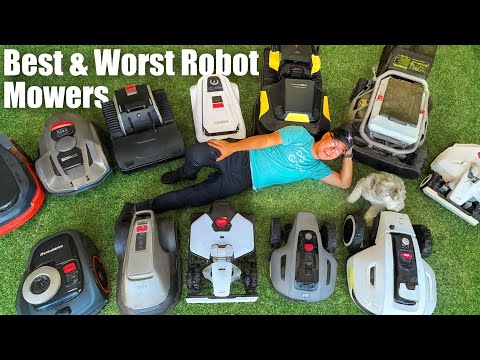
3.1 Best Overall: Segway Navimow X4 Series
If you’re dealing with thick St. Augustine and want something that just… works, the Navimow X4 series is about as close as it gets to a “set it and forget it” solution.
Pros
- Dual 180W motors for maximum torque.
- Slope capability up to 84% with AWD traction.
- Smart algorithm detects thicker patches and adjusts in real time.
Cons
- Premium investment/higher price point.
According to field analysis, it even outperforms many traditional self-propelled mowers on dense St. Augustine lawns, which is honestly wild for a fully autonomous machine.
Check Price on Amazon3.2 Best for Large, Complex Lawns: Lymow One Plus (Luba 1 Plus)
Got a big yard with uneven terrain, slopes, and thick patches that never grow evenly? This machine feels less like a typical robot mower and more like a tank built for lawns.
Pros
- Track-drive system for superior traction on spongy ground.
- High RPM blades (around the 6,000 RPM range).
- Combined RTK and V-SLAM for centimeter-level accuracy.
Cons
- Overkill for small, simple yards.
3.3 Best Commercial-Grade Option: Husqvarna Automower 450XH
Husqvarna has been in the robot mower game longer than most, and the 450XH shows that maturity. Instead of brute force, it focuses on consistency.
Pros
- Spiral blade system reduces fraying on grass blades.
- GPS-assisted navigation for organized patterns.
- Extended operation per charge for large lawns.
Cons
- Maximum cutting height tops out around 3.6 inches.
If you like to keep your lawn taller and lush, this limitation matters. Still, for reliability and long-term durability, it’s one of the safest bets.
Check Price on Amazon3.4 Best Budget-Friendly Option: Worx Landroid Vision AI
Not everyone wants to drop premium-level money on a robot mower—and that’s where the Worx Landroid Vision AI comes in. Setup is refreshingly simple compared to more complex systems.
Pros
- AI-based sensors (no boundary wires required).
- Accessible entry point for robotic mowing.
Cons
- Cutting height maxes out at 3.0 inches.
- Lower slope capability and aggressive前进 cutting power.
If your lawn is relatively flat, not overly thick, and you’re mainly looking for convenience over perfection—it works. But if your grass grows like a jungle, you’ll probably outgrow it quickly.
Check Price on Amazon4. Real-World Performance: Slopes, Wet Grass, and Obstacles
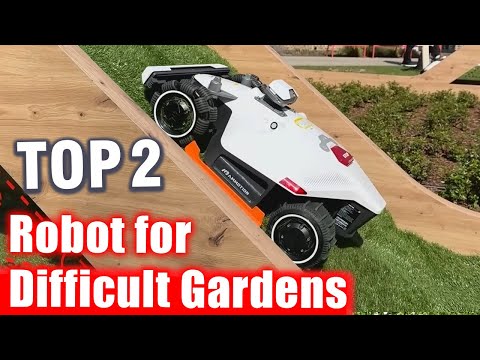
4.1 How Different Drive Systems Perform on Slopes and Spongy Lawns
On paper, most robot mowers promise “hill capability.” In reality? Thick grass changes everything.
Dense St. Augustine acts like resistance training for your mower. Add moisture, and suddenly your lawn feels soft, almost sponge-like under the wheels. That’s where weaker drive systems start slipping, spinning, or getting stuck halfway through a pass.
Step up to 4WD or AWD, and the difference is immediate. Power is distributed across multiple wheels, keeping the mower stable even when one side hits softer ground. This is why machines like the Lymow One Plus (with its tank-like drive system) feel so planted—they don’t lose momentum when the lawn pushes back.
And then there’s the extreme end. Some models, like the Navimow X4, are engineered for slopes up to 84%, which puts them in a completely different league. That kind of traction isn’t just about hills—it’s about staying consistent across uneven, thick turf.
Because in real life, your lawn isn’t perfectly dry. And your mower has to deal with that.
4.2 RTK vs LiDAR vs Vision Navigation in Dense Lawns
Navigation sounds technical—but it directly impacts how clean your lawn looks.
Let’s break it down simply.
| Technology | How it Works | Performance in Dense Lawns |
|---|---|---|
| RTK | Satellite + Base Station | Centimeter-level precision; struggles under heavy tree cover. |
| LiDAR | 3D Laser Mapping | Reliable in shade and low light; "feels" surroundings. |
| Vision | AI Cameras | Flexible setup; can be confused by "green blur" of tall grass. |
So what actually works best?
Sensor fusion.
The most advanced mowers combine RTK, LiDAR, and vision—switching between them depending on conditions. That’s how systems like the Lymow One Plus maintain accuracy in both open lawns and tree-covered areas.
In fact, modern systems can achieve centimeter-level positioning accuracy using RTK-based navigation, which is why your lawn ends up with those clean, straight stripes instead of random patches.
4.3 Obstacle Avoidance and Reliability in Thick Growth
Here’s something most people don’t think about—until it happens.
Your lawn isn’t empty.
There are toys, branches, uneven patches, garden edges… and in thick grass, many of these obstacles are partially hidden. That’s where robot mowers either feel smart—or painfully dumb.
- Lower-end models: Rely on bump sensors. They literally run into something, stop, and turn.
- Advanced systems: Use AI cameras, LiDAR, or sensor fusion to avoid objects before contact.
So what’s the takeaway?
Robot mowers are incredibly capable—but they still prefer a relatively tidy lawn. Think of them like a robot vacuum. The cleaner the environment, the better the result.
5. Ownership Reality: Setup, Maintenance, and Limitations

5.1 Wire-Free vs Boundary Wire Setup: What to Expect
Let’s be honest—setup is where many people either fall in love with robot mowers… or regret the purchase.
Wire-Free Setup
- Digital mapping via app
- Easy to adjust zones later
- No physical digging required
Boundary Wire Setup
- Tedious physical installation
- Hard to change landscaping
- Risk of wire damage over time
So it comes down to this:
- Want simplicity and flexibility? Go wire-free
- Want rock-solid reliability in tricky signal environments? Wired still works
For most modern homeowners, though, the convenience of wire-free is hard to beat.
5.2 Maintenance: Blades, Cleaning, and Software Updates
Here’s the part no one tells you: robot mowers are low maintenance—but not zero maintenance.
- Blades: These machines use small razor-style blades. Typical guidance suggests checking or replacing them every few weeks of active mowing.
- Cleaning: Thick grass—especially St. Augustine—holds moisture. A quick rinse or brush-off of the deck keeps things running smoothly.
- Software: Your mower gets updates for new features and bug fixes, usually handled painlessly through an app.
So no oil changes. No gas. No engine maintenance. But still… a little care goes a long way.
5.3 Limitations You Should Know Before Buying
Let’s clear up the biggest misconception: Robot mowers are not designed to rescue a jungle. They’re maintenance machines, not recovery tools.
As highlighted in real-world testing, objects left on the lawn—kids’ toys, branches, random debris—can interrupt mowing or get bumped around. Some mowers handle this better than others, but none are perfect.
5.4 Are Robot Mowers Worth It for Thick Grass Lawns?
This is the real question. Because these machines aren’t cheap.
But here’s what you’re really buying: time.
Instead of spending hours every week mowing, you let the robot handle it daily. That constant, light trimming actually improves lawn health—grass stays greener, denser, and more even because it’s never getting hacked down all at once.
6. Conclusion
Thick grass like St. Augustine and Bermuda doesn’t forgive weak equipment. If your mower lacks power, proper cutting height, or traction, the results show immediately—uneven cuts, torn blades, and constant frustration.
The solution isn’t just “any” robot mower. It’s the right combination of strong motors, dual-disc cutting systems, adjustable height up to that critical 3.5–4 inch range, and a drive system that can handle real-world terrain.
- Best Overall: Segway Navimow X4 stands out as the most complete solution.
- Best for Complexity: Lymow One Plus brings unmatched durability and traction.
- Proven Reliability: Husqvarna 450XH still holds its ground.
At the end of the day, success with robot mowing comes down to consistency. Keep the lawn trimmed regularly—and suddenly, that “impossible” thick grass becomes effortless.
Check Price on Amazon
FAQ
Q: What is the ideal cutting height for St. Augustine grass on a robot mower?
A: St. Augustine grass thrives when maintained between 2.5 and 4 inches. Most standard robot mowers top out at 3.6 inches, so it is critical to select a high-cut model like the Segway Navimow X4 that can reach the full 4-inch range to avoid scalping the lawn.
Q: Can robot mowers handle thick, wet Bermuda grass?
A: Yes, but it requires high torque and superior traction. Models with 180W+ motors and All-Wheel Drive (AWD) or track-drive systems are better equipped to handle the friction and moisture-heavy clippings typical of dense Bermuda lawns without stalling or losing wheel traction.
Q: Do I need a boundary wire for a thick grass lawn?
A: While traditional wired systems work, modern wire-free models using RTK-GPS or LiDAR are often better for thick lawns as they allow for precise digital mapping and easy boundary adjustments without the need to bury cables in dense, fibrous root systems.
Q: Why do some robot mowers struggle with dense turf?
A: Dense turf like St. Augustine grows with thick runners called stolons that create high physical resistance. Low-powered mowers lack the necessary RPM and torque to slice through these fibers, often resulting in torn grass blades, uneven patches, or the mower stalling entirely.
Q: How often should I replace blades when mowing thick grass?
A: Thick, coarse grass dulls razor-style blades faster than fine fescue. Based on typical usage patterns, it is recommended to inspect blades every 2-3 weeks and replace them if you notice any tearing or fraying at the tips of the grass blades.