
Do Robot Mowers Work at Night? Noise Levels, Wet Grass Performance & What You Need to Know
Aaron Cooper1. Introduction
There’s something incredibly tempting about the idea: your lawn quietly trims itself while you sleep, and you wake up to a perfectly manicured yard. No weekend chores. No sweating under the sun. Just… done.
Most homeowners worry about three things: Will the mower actually navigate properly in the dark? Is it quiet enough not to annoy the neighbors (or break local laws)? And what happens when grass is damp with dew?
The truth sits somewhere in the middle. Yes, modern robot mowers can run at night—but whether they should depends on technology, environment, and a few real-world trade-offs you don’t want to ignore.
2. Do Robot Mowers Work at Night? It Depends on the Navigation Technology

2.1 Why Some Robot Mowers Struggle in Low Light (Vision-Based Systems)
On paper, camera-based robot mowers sound smart—AI vision, object detection, edge recognition. In reality? Nighttime exposes their biggest weakness.
These systems rely on visible light to “see” your lawn. Once the sun goes down, everything changes. Shadows blur edges. Lawn boundaries fade into driveways. Obstacles become harder to classify. What looked like a clean mowing path during the day can turn into hesitation, missed patches, or inefficient zig-zagging at night.
Some premium models try to compensate with infrared sensors, extending usability into dusk or early morning. But full overnight mowing? That’s still a stretch.
If your goal is true “set it and forget it” automation, relying on vision alone can feel like trusting a driver who suddenly loses depth perception after sunset. It works… until it doesn’t.
2.2 RTK GPS and LiDAR: Why Advanced Models Handle Night Mowing Better
Now here’s where things start to get interesting.
RTK GPS (Real-Time Kinematic positioning) sounds technical, but the idea is simple: instead of guessing where it is, your mower knows its exact position down to a few centimeters using satellite correction signals. No light required. No guesswork.
In fact, centimeter-level positioning accuracy means your mower can follow the same precise paths at midnight as it would at noon. Straight lines stay straight. Edges stay sharp.
LiDAR takes a different approach. Think of it like a bat using echolocation—but with lasers. It sends out pulses, measures reflections, and builds a real-time 3D map of your yard. Total darkness? Doesn’t matter. Shadows? Irrelevant.
The result feels almost unfair compared to camera-only systems. While basic models hesitate, RTK and LiDAR-equipped mowers move with quiet confidence—gliding along pre-planned routes, avoiding obstacles, and covering ground efficiently.
2.3 Hybrid Systems: The Most Reliable Choice for 24/7 Automation
If you’re serious about overnight mowing, one word matters: redundancy.
Hybrid systems combine multiple technologies—typically RTK GPS, vision sensors, and sometimes LiDAR—into a single mower. Each system covers the others’ blind spots.
Picture this: your mower moves across an open lawn using RTK precision. Then it approaches a tree-covered corner where satellite signals weaken. Instantly, onboard vision or LiDAR takes over. No interruption. No confusion. Just continuous mowing.
This layered intelligence is why hybrid systems are widely seen as the most reliable setup for 24/7 automation. According to aggregated field data and industry testing, tri-sensor setups consistently deliver the highest level of night-time reliability across complex environments.
And the real benefit? Peace of mind.
Because the worst-case scenario isn’t just a missed patch of grass—it’s waking up to a stuck mower, a half-cut lawn, or a failed overnight run. Hybrid systems are designed to prevent exactly that.
3. Are Robot Mowers Quiet Enough for Night Use?
3.1 Typical Noise Levels: 55–70 dB Explained
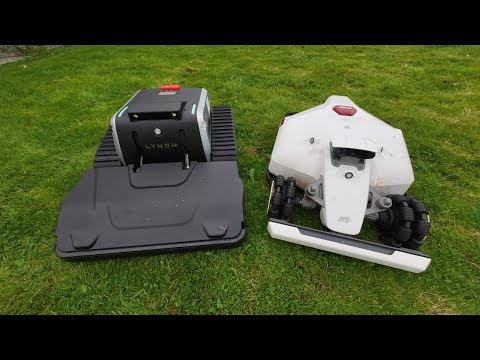
Let’s address the obvious question: are robot mowers actually quiet?
Yes—but context matters.
| Mower Type | Typical Noise Level | Comparison |
|---|---|---|
| Gas Mower | 85–100 dB | Motorcycle revving |
| Standard Robot Mower | 55–70 dB | Normal conversation |
| Premium Robot Mower | 58–60 dB | Air conditioner hum |
In day-to-day life, this is exactly why robot mowers feel so liberating. You can sip coffee on your patio while it works in the background. No ear protection. No stress. No “that neighbor” moment at 7 a.m.
3.2 Why Quiet Doesn’t Always Mean ‘Night-Friendly’
A 60 dB sound during the day? Barely noticeable.
The same 60 dB at midnight? Suddenly… very noticeable.
Why? Because everything else goes quiet. No traffic. No kids playing. No background noise to mask that steady mechanical hum. What used to blend in now stands out.
And robotic mowers don’t just make noise—they make continuous noise. Not a quick burst like a blender. Hours of steady operation.
3.3 Local Noise Laws: The Real Limiting Factor
Here’s the part most people overlook—and it’s the dealbreaker.
- Daytime allowances usually sit around 55–65 dB.
- Nighttime limits often fall to 45–55 dB.
- Most robotic mowers operate around 58–60 dB.
That creates a problem. In many cities, running any lawn equipment between roughly 10 p.m. and 7 a.m. is restricted or outright prohibited. Some regions even enforce fines for violations.
So even if your mower can run overnight, legally—and socially—you might not want it to.
The irony? These machines are designed to free up your time completely. But when it comes to nighttime use, your schedule still has to align with something else: your neighbors, and the rules of your neighborhood.
4. Wet Grass & Night Moisture: The Hidden Performance Trade-Off
4.1 How Dew and Humidity Affect Cutting Quality
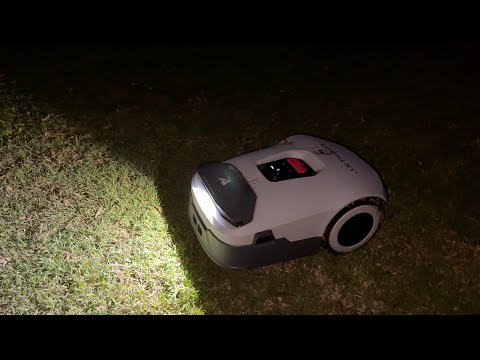
Here’s the part most people don’t think about until it’s too late: nighttime mowing almost always means wet grass.
Even if it didn’t rain, dew settles in as temperatures drop. By early morning, your lawn isn’t just slightly damp—it’s coated in moisture. And that completely changes how grass behaves under a blade.
That’s not just a cosmetic issue. Those rough, torn edges can leave grass more vulnerable to stress, disease, and discoloration over time. What should look like a smooth, carpet-like lawn can quickly turn patchy and inconsistent.
So while your mower is working overnight, the result often doesn’t match what you’d get from a dry daytime cut.
It’s one of those frustrating realizations: the automation worked perfectly… but the lawn doesn’t look like it.
4.2 Increased Blade Wear, Clogging, and Maintenance
Now imagine what’s happening underneath the mower.
Wet clippings don’t scatter nicely—they clump. They stick. They build up around the blades and deck like soggy debris that just won’t let go.
That creates resistance. The motor has to work harder. And over time, that extra strain shows up in ways you’ll definitely notice.
It’s the exact opposite of what most people expect from automation.
Think of it like washing greasy dishes with cold water. You can do it—but everything takes longer, and the results are never quite as clean. Wet mowing creates that same kind of friction inside your mower.
And if you’re running overnight schedules regularly? That buildup becomes routine. More maintenance. More intervention. Less “set it and forget it.”
4.3 Traction, Battery Drain, and Real-World Efficiency
Here’s where things get even more practical.
Wet grass doesn’t just affect cutting—it affects movement.
Moist soil reduces traction. Wheels slip more easily, especially on slopes or uneven ground. Instead of smooth, efficient paths, your mower may need to correct itself more often, wasting time and energy.
That extra effort translates directly into battery drain.
- Motors working harder to overcome resistance.
- Wheels fighting for grip on damp soil.
- Blades pushing through heavier, damp grass.
The result? Shorter run times, more frequent charging cycles, and less area covered per session.
And in real-world use, that can break the illusion of overnight efficiency. You expect to wake up to a fully maintained lawn—but instead, the mower may still be mid-cycle, or worse, stuck or delayed.
So yes, robot mowers can run at night.
But when moisture enters the equation, “can” doesn’t always mean “should.”
5. Safety, Wildlife, and Smart Scheduling: When Should You Actually Mow?

5.1 Why Night Mowing Can Be Risky for Wildlife
There’s a quieter consequence of nighttime mowing that rarely shows up on spec sheets: wildlife.
After dark, your lawn isn’t empty. Small nocturnal animals—hedgehogs, rabbits, and other ground-dwelling creatures—become active. And unlike humans, they don’t recognize a robot mower as something to avoid.
The result can be serious harm.
This isn’t just theoretical. Environmental concerns have already pushed some regions toward restrictions, including night-time mowing bans designed to protect nocturnal wildlife. The message is clear: even if the technology works, the ecosystem might not agree.
And it’s worth thinking about from a homeowner’s perspective. The whole point of automation is to make life easier—not to introduce risks you can’t see or control while you sleep.
5.2 Using App Scheduling to Optimize Mowing Times
Here’s the good news: you don’t need to rely on nighttime mowing to get the “hands-free” experience.
Modern robot mowers are built around scheduling. Through a simple app, you can set mowing windows, adjust frequency, and even react to changing conditions without stepping outside.
Some systems even detect rain automatically and pause operations, helping you avoid all the wet-grass problems we just talked about.
This is where robot mowers really shine—not just in automation, but in smart automation.
Instead of forcing your mower into the night, you can align it with the best conditions for performance, lawn health, and peace of mind.
5.3 Best Practice: Early Morning vs Night Operation
So what’s the sweet spot?
If nighttime seems appealing because it’s “out of the way,” early morning offers a much better compromise.
After sunrise, grass begins to dry. Visibility improves (even for basic systems). And you’re safely within most local noise regulations.
Late afternoon is another strong option—dry conditions, stable temperatures, and minimal disturbance.
Compared to night mowing, these windows solve almost every problem at once:
Pros of Daytime/Morning Mowing
- Better cutting quality
- Less wear and maintenance
- Lower risk to wildlife
- Fewer legal concerns
In other words, you still get the freedom of automation—just without the hidden downsides.
Because the goal isn’t just to mow anytime.
It’s to mow at the right time.
6. Conclusion: Should You Run Your Robot Mower at Night?
Technically, yes—robot mowers can run at night, especially if they use advanced systems like RTK GPS or LiDAR that don’t rely on light.
But real life is messier than specs.
Noise regulations, neighbor sensitivity, wet grass performance, and even wildlife safety all stack up against overnight mowing. What sounds like the ultimate convenience often leads to uneven cuts, more maintenance, and potential conflicts you didn’t plan for.
The smarter move? Use the automation—but schedule it wisely.
Early morning or late afternoon gives you cleaner results, fewer headaches, and a lawn that actually looks as good as you expect.
Because in the end, the goal isn’t just hands-free mowing.
It’s a lawn that looks effortless—and actually is.
FAQ
Q: Are robot mowers quiet enough to run at night?
A: Most robot mowers operate between 55–70 dB, similar to a quiet conversation. However, since ambient noise drops at night, this hum can become more noticeable to neighbors and may exceed local nighttime noise ordinances which are often stricter than daytime limits.
Q: Can camera-based robot mowers navigate in total darkness?
A: Vision-based systems typically struggle at night because they require visible light to identify boundaries and obstacles. Without infrared sensors or secondary navigation like RTK GPS, camera-only mowers may experience reduced efficiency, missed patches, or navigation errors after sunset.
Q: Does mowing wet grass at night damage the lawn?
A: Cutting grass coated in dew or moisture often results in a jagged, uneven trim because wet blades bend rather than stand upright. This can leave your lawn vulnerable to disease and leads to clumps of wet grass clogging the mower's deck.
Q: Is night mowing dangerous for local wildlife?
A: Yes, nighttime mowing poses a risk to nocturnal animals like hedgehogs or rabbits that may be active in your yard. Many environmental experts and local regions recommend avoiding overnight operation to protect these ground-dwelling creatures from accidental harm.
Q: What is the best time to schedule a robot mower?
A: The ideal window is mid-morning or late afternoon. During these times, the grass is usually dry, ensuring a cleaner cut, and the mower operates within legal noise limits without disturbing neighbors or disrupting local wildlife patterns.