
Robot Lawn Mower Buying Guide: How to Choose the Right Model for Your Yard
Aaron Cooper1. Introduction
Robot lawn mowers promise something almost magical: a perfectly trimmed lawn without sacrificing your weekends. But here’s the catch—choosing the right one isn’t about chasing the most expensive model or the flashiest features. It’s about your yard. Size, slopes, layout, trees, and even how your garden is shaped will determine whether your mower quietly does its job… or constantly gets stuck and frustrates you. Think of it this way: the mower adapts to the yard, not the other way around. Get that match right, and you’re buying back hours of your life every single week.
2. Start with Your Yard: The Foundation of Choosing the Right Robot Lawn Mower

2.1 Match Lawn Size to Mower Capacity (and Why Oversizing Matters)
Let’s start with the most common mistake: underestimating your lawn.
On paper, your yard might look like “just 0.25 acres.” In reality? Trees, flower beds, pathways, and awkward corners turn that into a maze. A mower rated exactly for your lawn size often ends up struggling—running out of battery, missing patches, or taking all day to finish.
Here’s a quick way to think about it:
- Small lawns (under ~0.15 acres): Basic navigation works fine
- Medium lawns (0.15–0.3 acres): You’ll want smarter path planning
- Large lawns (0.75 acres and up): Advanced navigation becomes essential
Why? Because robot mowers don’t “rush.” They maintain. They trim a little, often. And when your mower is slightly oversized, that maintenance feels effortless. When it’s undersized? It feels like it’s always catching up.
2.2 Slope and Terrain: When You Actually Need AWD
Now let’s talk about the part most people ignore—until their mower starts sliding backwards like it’s on ice.
Not all lawns are flat. And robot mowers feel that immediately.
Most standard models can handle gentle slopes just fine. But once you move beyond mild inclines, traction becomes everything. Based on industry benchmarks:
| Terrain Type | Incline Grade | Requirement |
|---|---|---|
| Flat to gentle slopes | ~10–20% | Standard Mower |
| Moderate slopes | ~20–35% | Enhanced Grip/Navigation |
| Steep slopes | 35%+ | AWD (All-Wheel Drive) |
In fact, most entry-level models top out around moderate inclines, while more advanced AWD machines are designed specifically for challenging terrain. Independent testing consensus shows that most standard robot mowers struggle beyond moderate slope ranges, which is exactly where users start experiencing slipping, missed cuts, or constant interruptions.
With AWD
- Steady, confident movement
- Handles tricky terrain
- Better stability on wet grass
Without AWD
- Spinning wheels
- Uneven cuts
- Occasional “rescue missions”
2.3 Layout Complexity: From Simple Lawns to Multi-Zone Gardens
Here’s where things get real. Two lawns can be the same size—but feel completely different to a robot mower.
A simple rectangular yard? Easy. A yard with trees, flower beds, narrow paths, and separate zones? That’s a navigation challenge.
Let’s break it down:
- Simple layouts: Open space, few obstacles → basic navigation works
- Moderate layouts: Irregular shapes, some obstacles → smarter mapping needed
- Complex layouts: Multiple zones, tight passages, lots of obstacles → advanced navigation is critical
The difference between random movement and intelligent mapping is simple: One eventually gets the job done. The other gets it done efficiently.
Modern robotic mowers with multi-zone mapping can handle this beautifully—moving from one area to another on a schedule. But simpler models? They either miss sections or require manual intervention.
2.4 Trees, Shade, and Signal Problems You Shouldn’t Ignore
This is the silent deal-breaker most buyers never see coming. Trees.
They look great. They provide shade. But for many robot mowers—especially GPS-based ones—they’re a nightmare.
Real-world testing repeatedly shows that GPS-based mowers can lose positioning under heavy tree cover, especially in areas with dense canopy or nearby buildings.
So what should you do? It depends on your yard:
- Minimal trees (0–10% coverage): RTK or GPS works great
- Light tree coverage (10–30%): Hybrid systems (GPS + camera) are safer
- Moderate to heavy trees (30%+): You’ll want LiDAR or advanced sensor systems
Why LiDAR? Because it doesn’t rely on satellites. It “sees” your yard using laser mapping, working just as well in shade as in sunlight. Think of it like this: GPS is like following a map from the sky, while LiDAR is like walking through your yard with your eyes open.
If your yard has a lot of trees, ignoring this factor will lead to constant interruptions, incomplete mowing, and endless tweaking. But get it right? Your mower just keeps going. Quietly. Reliably. Almost invisibly.
4. Performance, Reliability, and Maintenance: What Actually Matters Long-Term
4.1 Obstacle Avoidance and Real-World Navigation Reliability
Here’s where expectations meet reality.
You imagine your robot mower gliding effortlessly around toys, garden furniture, and maybe even your dog lounging in the sun. But not all systems handle this equally—and this is where the tech you chose earlier really shows its true value.
| Navigation Tech | Reliability Factors |
|---|---|
| AI Vision | Relies on lighting/contrast; can be confused by shadows or wet grass. |
| LiDAR | Builds 3D maps; works in any lighting; most consistent detection. |
| RTK-GPS | Precise in open spaces; struggles with signal loss near tall structures. |
AI vision systems are impressive on paper. They can recognize common objects and react in real time. But they rely heavily on lighting and contrast. That means shadows, wet grass, or low light can confuse them. Some users report situations where the mower hesitates… or worse, avoids perfectly mowable grass because it “thinks” it’s an obstacle.
LiDAR, on the other hand, feels almost unfair in comparison. Because it builds a 3D map of your yard, it doesn’t care if it’s bright sunlight or deep shade. It just sees structure. That’s why industry consensus consistently shows that LiDAR-based systems deliver the most consistent obstacle detection, especially in cluttered or shaded gardens.
Then there’s RTK. In open spaces, it’s incredibly precise. Straight lines. Clean coverage. But introduce signal loss, and obstacle handling becomes less predictable—especially if the system relies on camera fallback.
So what does this mean for your daily life?
- Kids leave toys outside → vision systems may hesitate
- Garden furniture moves → LiDAR adapts instantly
- Tree shadows shift → RTK may struggle without backup
If your yard is dynamic (and most are), reliability isn’t about specs—it’s about how the mower reacts when things aren’t perfect. And that’s the difference between a tool you trust… and one you constantly check on.
4.2 Battery, Coverage, and Why Mowing Takes Longer Than You Expect
Let’s clear up one of the biggest misconceptions.
Robot mowers are not fast.
If you’re used to finishing your lawn in 45 minutes with a gas mower, a robot will feel… slow. Painfully slow at first. But that’s by design.
These machines don’t attack your lawn—they maintain it.
Instead of cutting everything in one aggressive pass, they trim small amounts frequently. That’s why even high-end models often need multiple charging cycles to finish a medium or large lawn. In real-world testing, even lawns well within a mower’s rated capacity still required several hours—or even a full day—once charging breaks are included.
And yes, that can sound frustrating. But here’s the shift: you’re not waiting for it. It’s working while you’re inside, at work, or asleep. Quietly. Consistently.
Still, there are trade-offs:
- Larger lawns = multiple recharge cycles
- Advanced navigation (LiDAR, AI) = higher power consumption
- Complex layouts = longer total mowing time
So if you expect instant results, you’ll be disappointed. But if you think in terms of “always maintained,” it clicks. You stop scheduling mowing. Your lawn just… stays done. That’s the real win.
4.3 Maintenance Reality: Cleaning Sensors, Blades, and Systems
Let’s talk about the part nobody mentions in ads. Maintenance. Not the heavy, greasy kind you’d expect from a gas mower—but it’s not zero either.
Every navigation system comes with its own small responsibilities:
- LiDAR systems: need regular cleaning of the sensor dome. Dust buildup can gradually reduce accuracy.
- Camera-based systems: lenses must stay clean, especially if you have pollen, rain, or dirt.
- RTK systems: require occasional attention to the base station and clear sky visibility.
Then there’s the cutting system itself. These robots use small razor blades, not large spinning decks. They’re efficient—but they dull over time and need periodic replacement.
So yes, there’s still a little involvement:
- Quick yard check before runs
- Occasional cleaning
- Blade replacement every few months
But compared to pushing a mower in the heat? It’s nothing. A few minutes of light upkeep… in exchange for never spending your Saturday mowing again. That’s a trade most people are very happy to make.
5. Best Robot Lawn Mower Choices by Budget, Lawn Type, and Use Case

5.1 Best for Small and Simple Lawns
If your yard is small, flat, and mostly open, here’s the truth: You don’t need a high-end robot mower.
In fact, buying one would be like using a sports car to drive around your driveway—impressive, but unnecessary. For lawns under roughly 0.15 acres, simple systems work beautifully. Camera-based or basic GPS models are often the best fit because they’re easy to set up and don’t require complicated mapping or base stations.
Pros
- Extremely easy setup (No wires/calibration)
- Lower entry price point
- Compact and unobtrusive
Cons
- Coverage is less systematic (random patterns)
- Takes longer to finish the job
- Can struggle in low light
The biggest advantage? Simplicity. You take it out of the box, place it on the lawn, and it starts learning your yard with minimal setup. No wires. No satellite calibration. No overthinking. Still, for a clean, open lawn, it works. And honestly? That’s the sweet spot.
5.2 Best for Medium Lawns with Obstacles
Now we’re in the real-world sweet spot. A medium-sized yard with a few trees, some landscaping, maybe a patio or two. This is where most homeowners land—and where choosing the right balance really matters.
This is also where frustration begins… if you pick the wrong system. Pure camera models start to feel inefficient. Basic GPS isn’t precise enough. And suddenly, your mower is missing spots or taking forever.
This is where hybrid systems shine. RTK + camera (or VSLAM) offers a powerful balance:
- Precise navigation in open areas
- Visual fallback when GPS drops
- Better obstacle handling
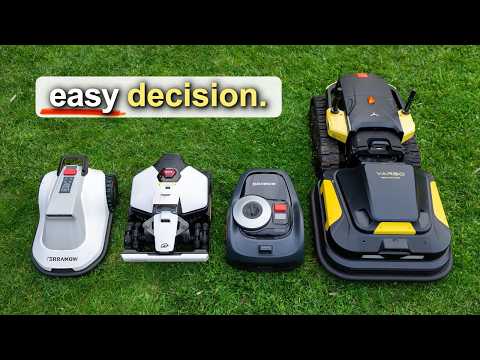
Models like the Sunseeker X3 Plus or Navimow series sit right in this category. They’re designed for medium lawns with moderate complexity—delivering structured mowing without the full cost of premium systems.
5.3 Best for Large, Complex, or Sloped Yards
This is where things get serious. Large lawns. Multiple zones. Steep slopes. Trees everywhere. If this sounds like your yard, let’s be blunt: entry-level and mid-range mowers will struggle. You’ll spend more time rescuing them than enjoying the automation.
This is exactly where premium systems justify their price. You’re looking for three things:
- AWD for traction on slopes
- Advanced navigation (RTK, LiDAR, or Tri-Fusion)
- Multi-zone mapping for complex layouts
For example, models like the Mammotion LUBA 3 AWD combine all of this—handling steep terrain, complex mapping, and advanced obstacle detection. These systems are designed for properties where simpler mowers fail.
5.4 Are Premium Features Like LiDAR and RTK Worth It?
This is the question everyone asks. Do you really need LiDAR? RTK? AWD?
| Feature | When It's Worth It | When It's Overkill |
|---|---|---|
| LiDAR | Heavy tree coverage / messy yards. | Simple, open rectangular lawns. |
| RTK GPS | Large spaces requiring perfect lines. | Small yards with high walls/shade. |
| AWD | Steep slopes or slippery terrain. | Flat suburban lots. |
Here’s the mistake most buyers make: They buy features instead of solving problems. If your lawn is simple, premium features won’t transform your experience. But if your yard is complex, they’re the difference between frustration and freedom.
So instead of asking, “Is this feature cool?” Ask: “Does my yard actually need this?” That one question can save you hundreds—and a lot of regret.
6. Conclusion: A Simple Decision Framework to Pick the Right Robot Lawn Mower
Choosing the right robot lawn mower isn’t about chasing the most advanced model—it’s about matching the machine to your yard.
Start with the basics: size, slope, layout, and tree coverage. These four factors determine almost everything. Then choose the navigation technology that fits those conditions—RTK for open precision, LiDAR for reliability under trees, or hybrid systems for balance. Finally, align your budget with your actual needs. Not your neighbor’s setup. Not marketing claims. Your yard.
There is no “best” robot lawn mower. Only the one that works effortlessly in your space.
Get that match right, and something amazing happens. Your lawn stays perfectly maintained… And your weekends stay yours.
FAQ
Q: How do I choose the right size robot mower for my yard?
A: Industry data suggests selecting a mower rated for 20-30% more area than your actual lawn size. This buffer accounts for layout inefficiencies, obstacles, and ensures the machine isn't overworked, leading to more consistent maintenance and fewer charging cycles throughout the week.
Q: Do I need an AWD robot lawn mower?
A: All-wheel drive (AWD) is essential if your yard features steep slopes exceeding 35%. While standard models handle gentle inclines, AWD provides necessary traction and torque to prevent slipping or getting stuck, especially on wet grass or uneven terrain commonly found in complex landscapes.
Q: Will a robot mower work in a yard with many trees?
A: High tree density can interfere with GPS and RTK signals. For yards with over 30% canopy cover, LiDAR-based navigation is recommended as it uses laser mapping to "see" the environment independently of satellites, ensuring the mower doesn't lose its position in shaded areas.
Q: What is the difference between RTK and LiDAR navigation?
A: RTK GPS provides high precision and straight cutting lines in open spaces but requires a clear view of the sky. LiDAR creates a 3D map of the surroundings, making it more reliable for obstacle detection and navigating under heavy shade where satellite signals often fail.
Q: How much maintenance do robot lawn mowers require?
A: Maintenance is minimal but necessary. Owners should regularly clean sensor domes or camera lenses, perform quick yard checks for debris like sticks or toys, and replace the small cutting blades every few months to ensure a clean, efficient trim of the grass blades.