
Rotating Mop Pads vs. Vibrating Mop Pads: Which Robot Mop Cleans Better for Your Home?
Aaron Cooper1. Introduction
Choosing a robot mop shouldn’t feel like decoding a spec sheet—but here we are. Rotating pads, vibrating pads, “sonic scrubbing”… it’s easy to assume one is clearly better. In reality, the difference shows up in very specific moments: dried coffee on tile, sticky kitchen floors, or that invisible film from pets.
The truth? Mop type matters—but not in isolation. Pressure, water control, and how clean the pad stays during a run often matter just as much. So instead of marketing claims, let’s break down how these two technologies actually perform where it counts: real floors, real messes, real life.
2. Rotating vs. Vibrating Mop Pads: Core Cleaning Performance Breakdown
2.1 Scrubbing Power: Continuous Rotation vs High-Frequency Vibration
Here’s the moment that decides everything: a dried splash on your kitchen floor that didn’t come off after your last cleaning cycle.
A vibrating mop will tap at it—fast, precise, almost like an electric toothbrush buzzing against the surface. It creates thousands of tiny movements that loosen light residue and dust film. For everyday maintenance, that’s often enough.
But rotating pads? They don’t “tap.” They scrub.
With continuous circular motion and torque, rotating mop pads drag fresh fibers across the same spot over and over, maintaining friction in a way that feels much closer to manual mopping. Industry comparisons consistently describe this as delivering scrubbing force similar to manual cleaning, especially when paired with downward pressure.
That difference becomes obvious the moment dirt fights back.
Short version:
- Vibrating: Precise, high-speed agitation
- Rotating: Sustained friction + torque
When the mess is stubborn, friction wins.
2.2 Stain Removal: Light Dirt vs Dried and Sticky Messes
Not all messes are created equal—and this is where the gap widens.
If your floors mostly deal with dust, footprints, or the occasional light spill, both systems perform well. Vibrating pads are especially good at lifting that thin, almost invisible layer of grime that builds up over a few days. Floors look refreshed. Job done.
But then comes the real-life chaos: dried coffee rings, sticky juice, sauce splatters that have been stepped on and baked into the floor.
This is where rotating pads pull ahead.
Because they maintain stronger mechanical action, they’re consistently described as better at breaking down:
- Dried food residue
- Sticky spills (juice, syrup, grease)
- Muddy paw prints and tracked-in dirt
There’s also a pattern seen across independent testing: systems with active scrubbing (like spinning pads) tend to score higher in stain removal than flat-style approaches, with results clustering around higher average stain test performance compared to flat pad designs.
So if your home sees real mess—not just dust—this difference isn’t subtle.
2.3 Edge and Corner Cleaning Differences
Now let’s talk about the most annoying part of any cleaning job: the edges. Baseboards. Corners. That thin line of grime that somehow survives every pass.
This is where design matters just as much as motion.
Rotating mop systems typically place their pads closer to the edge of the robot—and because the pads are spinning, they naturally “pull” cleaning action outward. The result? Better reach along walls and into corners.
Vibrating pads, on the other hand, are usually mounted within the robot’s footprint. That means they physically can’t extend as far. Even if the robot gets close, the cleaning action stops short.
Some comparative testing even highlights a measurable gap, with vibrating systems leaving small but noticeable uncleaned areas in corners—roughly the size of a palm.
You’ve probably seen this yourself:
The middle of the room looks spotless… but the edges still feel slightly gritty.
That’s not your imagination. It’s geometry.
So while vibrating pads can be more precise in open areas, rotating pads tend to win where dirt likes to hide most—along the edges you notice every single day.
3. Which Mop Technology Fits Your Home? Scenario-Based Recommendations
3.1 Homes with Pets, Hair, and Paw Prints
If you have pets, you already know the pattern: it’s not just hair—it’s the fine layer of dirt, oils, and mystery grime that builds up everywhere.
And here’s the frustrating part: vacuuming alone doesn’t fix that slightly sticky, dull-looking floor.
Rotating mop pads tend to handle this environment better. The continuous scrubbing motion helps break down that invisible film that pets leave behind, especially in high-traffic paths like hallways and around food bowls. It also does a better job dealing with muddy paw prints that have dried into the floor.
Vibrating pads still have a role, though. If your pet frequently leaves localized messes—like dried drool spots or food spills—their high-frequency motion can be effective at loosening those specific areas, especially when the robot performs multiple passes.
Best For: Rotating Pads
- Whole-home grime
- Heavy paw traffic
- Trapping fine fur in fibers
Best For: Vibrating Pads
- Spot cleaning specific sticky messes
- Localized dried drool spots
If your floors constantly feel like they need more than a quick wipe, rotation starts to feel like a necessity, not a luxury.
3.2 Sticky Kitchen Spills and Dried Food Stains
Kitchens are where robot mops either prove themselves—or completely fall apart.
Think about what actually ends up on your floor: dried coffee, sauce splatters, grease, juice that turned into a thin sticky layer overnight.
This is where vibrating (often called “sonic”) mops can shine in a very specific way. Their rapid back-and-forth motion focuses on a small area, almost like scrubbing in place. When a robot pauses or does multiple passes, that micro-scrubbing can break down stubborn spots surprisingly well.
That’s why many lab-style tests and product evaluations consistently show strong performance from vibrating systems on dried stains—especially when the robot is programmed to revisit the same area.
But here’s the catch: coverage.
Rotating pads may not “attack” a single نقطة (spot) as aggressively in one moment, but they scrub continuously across the entire floor. So while vibrating mops excel at targeted stain removal, rotating systems are better at cleaning the whole kitchen evenly—especially when there’s a general layer of grease or residue.
If your messes are occasional and localized, vibrating pads hold their own. If your kitchen sees daily chaos, rotating pads reduce the need for repeat runs.
3.3 Mixed Flooring: Tile, Hardwood, and Laminate
Most homes aren’t one surface—they’re a mix. Tile in the kitchen, hardwood in the living room, maybe laminate in the hallway.
And suddenly, cleaning isn’t just about power—it’s about control.
Rotating pads tend to perform better on textured surfaces like tile and grout. Their scrubbing motion can dig into those tiny grooves where dirt hides, which is why they’re often preferred for kitchens and entryways.
But that same aggressive motion can feel like overkill on delicate flooring. Hardwood and laminate don’t need heavy scrubbing—they need controlled moisture and gentle contact.
That’s where vibrating pads often feel more comfortable. Their flatter design and lighter pressure make them better suited for maintenance cleaning on sensitive surfaces, especially when paired with careful water control.
| Flooring Type | Recommended Technology |
|---|---|
| Tile & Grout (Textured) | Rotating Pads |
| Hardwood & Laminate | Vibrating Pads |
| High-Traffic Entryways | Rotating Pads |
That said, there’s a bigger truth most people overlook: water management matters more than motion. Too much water—or a dirty pad—will ruin results on any floor type.
3.4 Light Daily Maintenance vs Deep Cleaning Needs
Let’s be honest—most people don’t need a robot mop to deep-clean every day. What they really want is consistency: floors that always feel clean without thinking about it.
If that’s your goal, vibrating mop systems are often enough. They’re great at maintaining already-clean floors—lifting dust, removing light footprints, and preventing buildup before it becomes visible.
Run it daily, and your floors rarely get “dirty enough” to need anything stronger.
But if you skip a few days… or life happens… everything changes.
That’s where rotating pads step in. When dirt has had time to settle—when stains dry, when traffic builds up—stronger scrubbing becomes necessary. Rotating systems are simply better at catching up and restoring that “just cleaned” feeling in fewer passes.
Maintain (Vibrating)
- Clean a little, often
- Efficient for dust/footprints
Recover (Rotating)
- Clean less frequently
- Heavier messes/dried stains
And if you’ve ever had to re-run a cleaning cycle just to get the result you wanted… you already know which one you needed.
4. How the Technology Actually Works (And Why Specs Can Be Misleading)
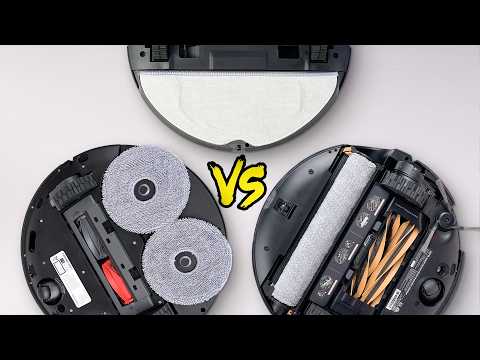
4.1 The Cleaning Science: Pressure, Motion, and Sinner’s Circle
Here’s the part most marketing pages skip: cleaning isn’t just about spinning faster or vibrating harder.
Professional cleaning follows something called Sinner’s Circle—a simple framework built on four factors: time, agitation (movement), chemicals, and temperature. Robot mops can’t soak a stain for 10 minutes like you would with a sponge, so they rely heavily on mechanical action—that’s where rotating and vibrating systems come in.
A vibrating pad can buzz thousands of times per minute, but without enough downward pressure, it’s basically tickling the dirt. On the flip side, a rotating pad without proper water control can just smear grime around like a damp paper towel.
Real-world performance comes from balance:
- Enough pressure to create friction
- Controlled moisture to loosen dirt
- Clean pads that don’t redeposit grime
That’s why two robots with “similar mop types” can feel completely different in your home. One leaves your floor fresh. The other leaves streaks—and frustration.
It’s not just how it moves. It’s how the entire system works together.
4.2 RPM vs Vibration Frequency: What These Numbers Really Mean
Let’s decode the numbers that show up in product listings.
You’ll see things like:
- “High RPM spinning pads”
- “3,000 vibrations per minute”
Sounds impressive. But what do they actually do?
For rotating pads, RPM (rotations per minute) determines how often the pad scrubs over the same spot. Higher RPM means more passes—but only if the pad is pressed firmly enough to maintain contact. Too fast without pressure? The pad can glide over dirt instead of gripping it.
For vibrating systems, frequency tells you how fast the pad moves back and forth. Some models reach thousands of micro-scrubbing motions per minute, which helps break up light dried stains. But again—without enough force behind those movements, the effect is limited.
- Rotation = longer, stronger scrubbing strokes
- Vibration = rapid, tiny scrubbing taps
Neither is automatically better. High numbers don’t guarantee better cleaning—they only matter if friction and pressure are there to support them.
So when you see big specs? Treat them as potential—not proof.
4.3 Water Flow, Pad Saturation, and Base Station Cleaning
Now let’s talk about the silent performance killer: dirty mop pads.
Imagine mopping your kitchen floor… and never rinsing the mop. That’s exactly what happens inside many robot mops during a long cleaning cycle.
As the pad collects dirt:
- It becomes saturated
- Friction drops
- And instead of cleaning, it starts spreading grime
This is especially noticeble on sticky floors—you’ll see streaks, or worse, that slightly tacky feeling under your feet.
Both rotating and vibrating systems suffer from this. In fact, independent testing consistently shows that pad cleanliness during the run is one of the biggest factors in real-world results—not the motion type itself.
This is where base stations come in.
More advanced robots:
- Wash pads during or after cleaning
- Separate dirty and clean water
- Re-wet pads with controlled moisture
Rotating systems often have an advantage here because their spinning motion helps scrub the pads against the wash tray. Vibrating pads can be harder to clean thoroughly unless the dock design compensates for it.
Clean pad = clean floor. Every time.
5. Real-World Performance: What Tests and Reviews Actually Show
5.1 Side-by-Side Test Results: Are Differences Really That Big?
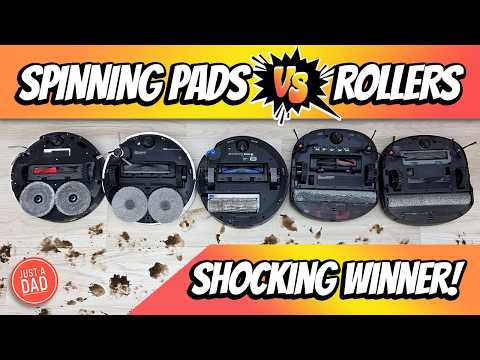
Here’s the surprising truth: when you put rotating and vibrating systems head-to-head in controlled tests, the gap isn’t always dramatic.
Across multiple independent comparisons, spinning systems tend to edge ahead on tougher stains—but not by a landslide. In fact, aggregated testing shows average stain scores between spinning systems and other active designs are extremely close, with differences often coming down to the robot itself rather than the mop type.
Translation?
A well-designed robot with vibrating pads can outperform a poorly designed one with rotating pads.
Why? Because factors like:
- Navigation (does it actually cover the whole floor?)
- Water control (too wet vs too dry)
- Cleaning patterns (single pass vs multiple passes)
…all play a huge role in results.
So if you’re expecting a night-and-day difference just from “rotating vs vibrating”—that’s not how it plays out in real homes.
The mop type sets the ceiling. The robot design determines how close you get to it.
5.2 Consistency Over Time: Pad Wear, Dirt Build-Up, and Reliability
Day one performance is easy. Week three? That’s where things get real.
Over time, both systems face the same enemy: buildup.
Rotating pads tend to degrade gradually. As the fibers wear down and collect residue, scrubbing power slowly drops—but it’s predictable. You’ll notice it, wash or replace the pads, and performance comes back.
Vibrating pads, on the other hand, can feel great… until they don’t. Because they rely heavily on surface contact and fine motion, once the pad gets too dirty or worn, effectiveness can drop off more noticeably.
And then there’s the biggest factor: maintenance habits.
Skip a few washes, and suddenly:
- Floors look streaky
- Sticky spots reappear
- Cleaning feels inconsistent
This isn’t a tech failure—it’s a maintenance issue.
5.3 Performance Across Floor Types and Mess Conditions
So how do these systems actually behave across your home?
Let’s break it down where it matters most.
| Scenario | Rotating Pads | Vibrating Pads |
|---|---|---|
| Hardwood floors | Strong cleaning, but depends on water control | Gentle, consistent maintenance cleaning |
| Tile & grout | Better at digging into texture and lifting dirt | Good surface cleaning, weaker in grout |
| Light dust & footprints | Excellent | Excellent |
| Dried stains | Better one-pass removal | Often needs multiple passes |
| Sticky spills | Strong scrubbing, less smearing | Can smear before breaking down |
| High-traffic areas | Preferred | Adequate for upkeep |
The pattern is consistent across sources:
- Rotating pads dominate in deep cleaning scenarios
- Vibrating pads shine in daily maintenance and lighter messes
But here’s the nuance most people miss:
Fresh spills? Neither is perfect—they can both spread liquid if the pad saturates.
Heavy grime? Both may need multiple passes if water and pressure aren’t dialed in.
In other words, no system is magic. But if your floors regularly go beyond “light dust,” the difference becomes very real—and very noticeable under your feet.
6. Conclusion: Rotating vs. Vibrating Mop Pads—Which Should You Choose?
So, which one actually cleans better?
Choose Rotating If...
- Your home deals with real mess: sticky spills, dried stains, pet traffic.
- You want that “just manually cleaned” feeling in fewer passes.
- You need better edge cleaning and deep scrubbing.
Choose Vibrating If...
- Your goal is simple daily maintenance of already-clean floors.
- You prefer an efficient, gentle cleaning system for hardwoods.
- You focus on light dust and footprint removal.
Here’s the honest takeaway: the mop type matters—but it’s not the whole story. Water control, pad cleanliness, and overall robot design often matter just as much.
So don’t chase specs alone. Think about your floors, your messes, and how often you clean.
Because the best robot mop isn’t the one with the fanciest tech. It’s the one that actually keeps your floors clean—without you thinking about it.
FAQ
Q: Which mop type is better for dried kitchen stains?
A: Rotating mop pads generally perform better on dried and sticky stains because they provide sustained friction and circular torque. While vibrating pads use high-frequency agitation to loosen light residue, they often require multiple passes to fully remove baked-on food or coffee rings compared to rotating systems.
Q: Are rotating mop pads safe for hardwood floors?
A: Yes, but water management is key. While rotating pads offer more aggressive scrubbing, most modern robots allow you to adjust water flow levels. For delicate hardwood, using a lower water setting with rotating pads ensures a thorough clean without risking moisture damage to the wood planks.
Q: Do vibrating mops clean corners and edges effectively?
A: Vibrating pads are often mounted within the robot's footprint, which can leave small uncleaned gaps along baseboards. In contrast, rotating pads are typically positioned closer to the edges of the device, allowing them to pull cleaning action further into corners and along wall edges more effectively.
Q: How often should I wash the mop pads?
A: To prevent streaking and grime redistribution, pads should be cleaned after every significant run. Many advanced robots now feature base stations that automatically wash and dry pads. Without clean pads, both rotating and vibrating systems will lose friction and simply smear dirt around the floor.
Q: Does a higher vibration frequency mean better cleaning?
A: Not necessarily. While high vibration frequencies (like 3,000 movements per minute) help agitate surface dust, cleaning effectiveness depends equally on downward pressure. Without sufficient force pressing the pad against the floor, high-speed vibrations may only glide over stubborn grime rather than scrubbing it away.