
Best Robotic Pool Cleaners for Freeform Pools with Complex Steps (Smart Navigation & Full Coverage Guide)
Aaron Cooper1. Introduction
Freeform pools look incredible—curved edges, built-in benches, tanning ledges, and those elegant sweeping steps. But cleaning them? That’s where the nightmare begins.
Traditional robotic pool cleaners are built for rectangles. Straight lines. Predictable paths. Drop one into a freeform pool, and suddenly it’s spinning in corners, missing entire sections, or getting confused around steps.
The result? You’re still out there brushing walls and scrubbing the waterline on a Saturday morning.
In this guide, we’ll break down what actually works: the features that matter, the models that can handle complex layouts, and—just as important—the real limitations you need to know before you buy.
2. What Makes a Robotic Pool Cleaner Suitable for Freeform Pools?

2.1 Full Coverage Is Non-Negotiable: Floor, Walls, and Waterline
Let’s start with the biggest mistake people make: buying a robot that only cleans the floor.
It sounds fine—until you notice that greasy ring forming along your pool’s edge. That’s the waterline, and it’s where the worst grime lives. Oils, sunscreen, algae… it all collects right there. In fact, industry consensus shows that the majority of bacteria and algae buildup concentrates at the waterline—not the floor.
For freeform pools, this gets even worse. Curves and irregular edges mean more surface area for buildup—and more places for weak robots to miss.
What you want is true “full coverage”: a machine that climbs walls, transitions smoothly, and actively scrubs along the waterline—not just bumps into it and falls back down.
Because when it works, the difference is immediate. You stop seeing that dull film. The tiles actually shine. And for once, your pool looks clean everywhere—not just the bottom.
2.2 Smart Navigation and Obstacle Avoidance for Irregular Shapes
Now here’s where most robots completely fall apart: navigation.
In a rectangular pool, even a basic robot can bounce around and eventually cover most areas. But throw in curved walls, steps, benches, and ledges? Chaos.
Cheap models tend to move randomly. They’ll clean one corner three times… and completely ignore another. Worse, they get stuck—wedged against steps or spinning endlessly in tight curves.
Some models even use multiple sensors to detect inclines and edges, allowing them to climb walls or change direction before getting stuck. Others let you control cleaning zones via an app—especially useful if your pool has tricky areas like deep curves or long benches.
The result? Less babysitting. Fewer missed spots. And a robot that actually finishes the job instead of giving up halfway through.
2.3 Cable Length, Tangle-Free Swivel, and Reach in Complex Layouts
Here’s something most buyers don’t think about—until it’s too late. Cable length.
In a simple pool, a shorter cable might work fine. But in a large freeform layout with curves and obstacles, that cable becomes the robot’s lifeline. Too short, and it simply can’t reach certain areas. Too stiff or tangled, and it starts dragging itself off course.
That’s why premium models typically come with longer cables—often in the 60 to 70-foot range. That extra length isn’t just convenience. It’s coverage.
And then there’s the swivel.
Without a tangle-free swivel, the cable twists as the robot moves, especially around curves and steps. Over time, it tightens, restricts movement, and turns your “automatic cleaner” into something you constantly have to untangle.
A good swivel system prevents that entirely. The robot moves freely, the cable stays relaxed, and you don’t have to play lifeguard every time it runs.
It’s one of those features you’ll never notice—until you don’t have it.
2.4 Brush Design and Surface Adaptation on Steps and Slopes
Not all brushes are created equal—and in a freeform pool, that matters more than you’d think.
Standard brushes can handle flat surfaces just fine. But when the robot hits a slope, a curved wall, or a step transition? That’s where performance drops off fast.
Some designs—like solid blade-style brushes—maintain better contact across uneven surfaces. Instead of lightly skimming over dirt, they stay planted and scrub aggressively, even when moving between levels.
This becomes especially important around steps and benches. These areas collect fine debris and algae, but they’re also where robots tend to lose traction or glide over without cleaning properly.
Dual active brushes help too. They increase agitation, lifting debris from textured surfaces and making it easier for the suction system to pull everything in.
The difference isn’t subtle. One robot leaves behind a faint dusty layer you can feel under your feet. The other? Smooth, clean surfaces you don’t even think about.
3. Top Robotic Pool Cleaners for Freeform Pools with Complex Steps
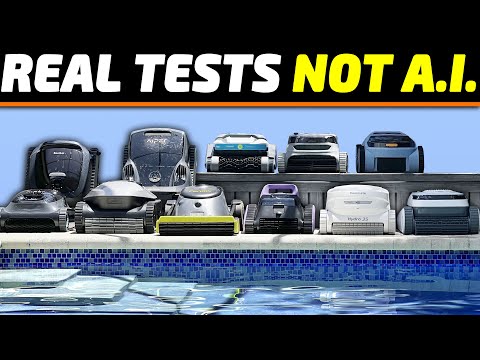
3.1 Best Premium Picks for Large and Complex Pools
If your pool has multiple curves, long benches, and deep ends, this is where premium models earn their price.
Pros
- Extended reach for large layouts
- Full coverage (floor, walls, waterline)
- Solid blade brush designs for uneven surfaces
- Advanced app or remote control navigation
Cons
- Significantly higher initial investment
- More complex components to maintain
The Polaris P965iQ stands out for one simple reason: reach. With a 70-foot cable designed specifically for large and irregular pools, it can navigate layouts that would leave shorter-cable robots stranded halfway. Combine that with full coverage (floor, walls, waterline) and app-based control, and you get a cleaner that can be tailored to your pool’s exact shape.
Then there’s the Polaris 9550 Sport. It delivers nearly identical coverage and cable length but swaps app control for a motion-sensing remote. That might sound like a downgrade, but for many users, it’s actually more intuitive—especially when guiding the robot around tricky zones.
3.2 Best Mid-Range Options with Smart Features
Not everyone needs—or wants—to spend premium-level money. The good news? There are solid mid-range options that still handle complex pools surprisingly well.
The Dolphin Proteus DX5i is a standout here. It combines full coverage with app control and flexible cleaning cycles, including a faster “quick clean” mode. That shorter cycle is perfect if you’re running frequent maintenance instead of waiting for your pool to get visibly dirty.
The Aqua Products Evo 614iQ takes a slightly different approach. It focuses on balanced performance—dual active brushes, full coverage, and app connectivity—without pushing the price too high.
Both models include tangle-free swivel cables and enough length to handle moderately complex layouts. They won’t feel as “overbuilt” as premium Polaris units, but they get the job done for most freeform pools.
3.3 Budget-Friendly Options That Still Handle Irregular Shapes
Let’s be honest—budget robots are where expectations need a reality check.
Take the Dolphin Proteus DX4. It offers full coverage, including waterline cleaning, which is rare at this price point. For simpler freeform pools, it can absolutely keep things under control.
But here’s the catch.
You might notice it cleaning the same area repeatedly while ignoring another. Or struggling to maintain consistent wall coverage. And if you step down even further—models that skip waterline cleaning entirely—you’re back to manual scrubbing again. Which defeats the whole purpose.
So yes, budget options can work. But they come with trade-offs: more oversight, less precision, and occasionally… a little frustration.
Sometimes that’s fine. Sometimes it’s exactly what makes people upgrade later.
4. Real-World Performance: Wall Climbing, Suction, and Filtration Compared
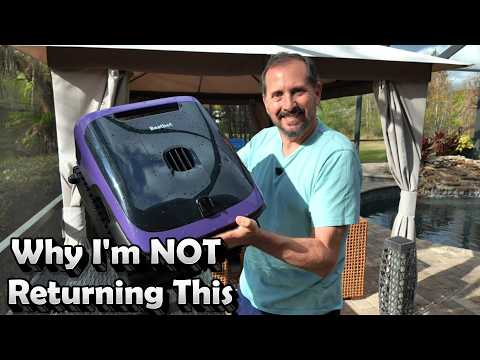
4.1 Wall Climbing and Step Handling in Practice
On paper, almost every robotic cleaner claims “wall climbing.” In reality? That’s where the differences become painfully obvious.
Drop a mid-range robot into a freeform pool with curved walls and steps, and you’ll often see hesitation. It starts climbing… pauses… slides back down. Or worse, it reaches a step and just sits there, confused.
Now compare that to models like the Dolphin Nautilus CC Plus or AiRROBO PC10. Some units even approach steps one level at a time, pivoting to clean instead of trying (and failing) to power through. That’s the difference between partial coverage and something that actually feels autonomous.
4.2 Suction Power: Why Corded Models Still Dominate
If you’ve ever watched a weak robot glide over debris without picking it up, you already know this frustration. It looks like it’s cleaning. It’s not.
Here’s why: suction power isn’t just about picking up leaves—it’s about consistency. Freeform pools have slopes, transitions, and uneven debris zones. Weak suction means dirt gets pushed around instead of removed.
Across independent comparisons, one conclusion keeps showing up: corded robotic pool cleaners deliver significantly stronger and more consistent suction than cordless models.
And you can feel it in real use. Corded robots stay locked to the surface. They don’t lose power halfway through a cycle. They don’t “give up” on heavier debris like sand or silt.
| Feature | Corded Models | Cordless Models |
|---|---|---|
| Suction Power | Stronger and more consistent | Often feature weaker motors |
| Performance | No power loss halfway through cycle | Shorter effective cleaning performance |
| Debris Handling | Better for heavy debris like sand | Convenient without cable management |
So if your pool has deep ends, benches, or heavy debris buildup… power matters. A lot.
4.3 Filtration Systems: From Mesh Filters to NanoFiltration
Let’s talk about something most people ignore—until their pool still looks cloudy after cleaning: Filtration.
Basic robots use simple mesh baskets. They’ll grab leaves, bugs, maybe some dirt. But fine particles? Sand, silt, algae? Those slip right through.
That’s why higher-end models use advanced filtration systems—often described as nano or ultra-fine filters. Think of it like upgrading from a kitchen strainer to a high-end air purifier.
Instead of just catching what you can see, these filters trap the stuff you can’t. The difference shows up fast. Water looks clearer. That dull haze disappears. And you stop second-guessing whether the robot actually did anything.
Because at the end of the day, a robot that “moves dirt around” isn’t cleaning. It’s just pretending.
4.4 Performance in Large and Irregular In-Ground Pools
Here’s where everything comes together—and where weaker robots fall apart. Large freeform pools aren’t just bigger. They’re unpredictable. Long curves, multiple depth zones, benches, steps… it’s a navigation nightmare.
In real-world comparisons, performance in these pools has very little to do with price—and everything to do with three things:
- Navigation: Mapping the layout effectively.
- Power: Maintaining suction on slopes.
- Coverage Logic: Ensuring no spots are missed.
Lower-end units often get stuck, repeat paths, or abandon difficult areas entirely. This is why models like the Dolphin Nautilus CC Plus are consistently recommended for non-rectangular pools—they balance smart navigation with reliable wall climbing and consistent suction.
5. Can Robotic Pool Cleaners Really Handle Steps and Ledges?
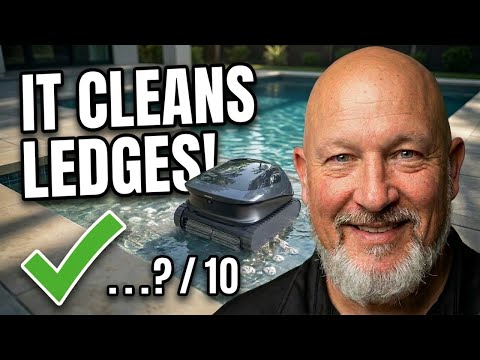
5.1 The Truth About Cleaning Stairs, Benches, and Tanning Ledges
Let’s clear this up—because this is where expectations usually crash. Most robotic pool cleaners do not fully clean stairs, benches, or tanning ledges.
Not because they’re poorly designed, but because of physics. These machines rely on water flow for movement and suction. When water gets too shallow, they lose stability, traction, or both.
That’s why even high-end models only partially handle these areas. They might climb onto a lower step. They might brush along the edge. But full, consistent cleaning? Still out of reach for most consumer robots.
5.2 How Modern Robots Avoid Getting Stuck
Now here’s the good news: getting stuck is far less of a problem than it used to be. Older or budget robots tend to wedge themselves into corners or spin endlessly against steps. You’ve probably seen it—wheels turning, nothing happening.
Modern units handle this differently. They use sensors to detect resistance, inclines, and obstacles. When something feels “off,” they don’t keep pushing—they change direction. Some models even reverse, pivot, and reroute automatically.
It’s subtle, but it makes a huge difference. Instead of babysitting your robot every 20 minutes, you can actually leave it alone and trust it to finish the job. Even in pools with benches, drains, or tight curves.
5.3 Workarounds to Minimize Manual Cleaning
So if robots can’t fully clean stairs… what’s the move?
- Brush Debris Down: Brush debris from steps and ledges down into the main pool area before running your robot.
- Let the Robot Floor Clean: Once the debris is on the floor, the robot can handle it easily.
- Choose Better Navigation: Reduce manual work by choosing models with better navigation and wall coverage.
It takes a couple of minutes. And it saves you from scrubbing everything by hand later. If your pool has a lot of shallow zones, consider that when buying. Some specialized models are designed to handle lower water depths, but they’re still the exception—not the rule.
Bottom line: you’re not eliminating manual cleaning entirely. But you are shrinking it down to something quick, predictable, and manageable.
6. Conclusion
Freeform pools are beautiful—but they demand more from your cleaning equipment. If you want real automation (not frustration), focus on three things: full coverage, smart navigation, and consistent corded power. These are what separate robots that “look busy” from ones that actually finish the job.
Premium models handle complex layouts best, especially with long cables, strong suction, and better obstacle handling. Mid-range options can still perform well—but expect a few compromises. Budget robots? They work, but they’ll need more oversight.
And when it comes to stairs and ledges, keep expectations realistic. No robot fully replaces manual cleaning there—yet. But here’s the win: instead of spending hours scrubbing your pool, you’re down to a few quick touch-ups.
FAQ
Q: Can robotic pool cleaners clean irregular steps and ledges?
A: Most robotic cleaners struggle with shallow stairs and tanning ledges due to physics and water depth requirements. While high-end models can navigate some transitions, we recommend brushing debris from stairs into the main pool area for the robot to collect, as manual touch-ups are still occasionally required.
Q: Why are corded robots recommended for freeform pools?
A: Data shows corded models provide more consistent suction and power compared to cordless versions. In complex freeform layouts, the constant power supply ensures the robot can handle steep inclines and long cleaning cycles without losing performance or getting stranded halfway through the job.
Q: What is a tangle-free swivel and why is it important?
A: A swivel is a mechanical part that allows the cable to rotate as the robot moves. In freeform pools with many curves and turns, this prevents the cord from knotting, which otherwise restricts the robot's reach and can lead to mid-cycle interruptions or mechanical strain.
Q: Does the robot need smart navigation for a curved pool?
A: Yes. Unlike rectangular pools where random paths eventually cover most spots, curved walls and irregular shapes often trap basic robots. Advanced navigation uses sensors to map the layout, ensuring the unit doesn't get stuck in tight corners or repeatedly clean the same area.
Q: How does waterline scrubbing benefit a freeform pool?
A: Algae and oils concentrate at the waterline, especially in the tight curves of freeform designs. Choosing a robot with active waterline scrubbing ensures these localized buildup zones are cleaned automatically, significantly reducing the need for manual scrubbing and maintaining the aesthetic of your tiles.