
Cordless vs. Corded Robotic Pool Cleaners: Spec & Convenience Comparison
Aaron Cooper1. Introduction
If you’ve ever stood by your pool, staring at leaves, sand, and that stubborn cloudy haze, you already know the real dilemma: do you want maximum cleaning power, or maximum convenience?
Cordless pool robots promise freedom—no cables, no setup, just drop and go. Sounds perfect… until you’re pulling it out, charging it, and wondering why the deep end still looks dusty. On the flip side, corded models feel a bit old-school—but they quietly deliver the kind of deep, hands-off cleaning most pool owners actually want.
This guide breaks it down from two angles that truly matter: raw performance specs and real-life usability. Because the right choice isn’t about hype—it’s about how much time (and frustration) you’re willing to save.
2. Spec-Level Breakdown: Cordless vs. Corded Performance Differences
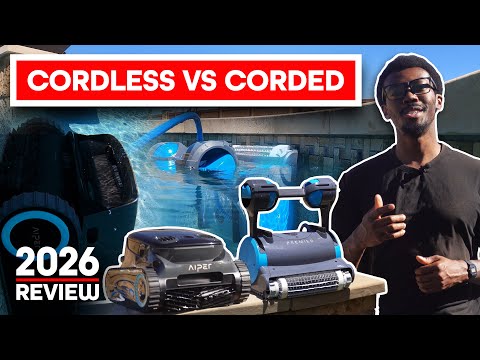
2.1 Suction Power & Cleaning Strength: Why GPH Actually Matters
Let’s start with the one thing that decides whether your pool looks “okay” or crystal clear: suction power.
Most people glance at features and skip the numbers—but here’s the reality. Corded robotic cleaners typically operate in the 4,000–5,000+ GPH range, while cordless models sit somewhere between 1,200–3,000 GPH. That’s not a small gap. It’s a completely different league.
Now picture this:
You’ve got leaves stuck in corners, fine sand settled into the floor texture, maybe even early algae buildup. A lower-powered cordless robot might glide over it… and leave half behind. You won’t notice immediately. But give it a few days? Cloudy water creeps back.
Independent pressure-based testing (measuring real suction force, not just marketing flow rates) consistently shows corded units pulling significantly stronger intake force—sometimes nearly double. And you can feel it. Literally. Debris disappears instead of dancing around.
That’s the difference between:
- “It ran.”
- And “It actually cleaned.”
2.2 Runtime & Coverage: Unlimited Power vs Battery Limits
Now let’s talk about something that sounds boring… until it ruins your weekend: runtime.
Corded robots? They don’t care how big your pool is. Plug them in, and they’ll run as long as needed. One full cycle. No interruptions. No compromises.
Cordless models, on the other hand, typically run 60 to 180 minutes per charge. Some premium options stretch longer—but the limitation still exists: the clock is always ticking.
You end up with:
- Clean floor
- Missed walls
- Untouched waterline
And now? You’re either running a second cycle—or accepting “good enough.” Even worse, daily use becomes a routine:
- Charge it
- Drop it in
- Pull it out
- Charge it again
Corded models eliminate all of that. They finish the job in one go. Every time. So the real question isn’t “How long does it run?” It’s: Can it finish your entire pool in one shot?
If not, you’re not saving time—you’re creating a new chore.
2.3 Filtration & Debris Handling: Nano Filters vs Basic Mesh
Here’s something most buyers don’t realize until it’s too late: Not all “clean” pools are actually clean.
Many cordless robots rely on basic mesh filters—typically around 180 microns. That’s fine for leaves and visible debris. But the stuff that actually makes your water look dull? Fine dust, pollen, early algae? That slips right through.
Corded models, especially higher-end ones, often support advanced systems like NanoFiltration™—designed to capture microscopic particles that standard filters miss entirely.
| Filter Type | Comparison |
|---|---|
| Mesh filter | Kitchen strainer |
| Nano filter | High-end water purifier |
But here’s the catch—and it’s a big one. Those ultra-fine filters require strong, consistent water flow. And that brings us back to power. Cordless robots simply don’t have the sustained suction needed to push water through dense filtration systems effectively.
Corded Result
- Actually cleaner water
- Captures microscopic particles
Cordless Result
- Cleaner-looking pool only
- Misses fine dust and algae
2.4 Navigation & Full Pool Coverage: Smart Mapping vs Time Constraints
Modern pool robots are smarter than ever. Many now use advanced navigation systems—similar to robotic vacuums—mapping your pool to avoid random zig-zag cleaning.
(Some even rely on SLAM—Simultaneous Localization and Mapping—which basically means the robot builds a mental map of your pool as it cleans.)
In contrast, corded robots don’t rush. They methodically cover:
- Floor
- Walls
- Waterline
And yes—most cordless models can climb walls and reach the waterline. But consistency is the issue. When battery drops or debris load increases, performance dips. Corded units? Same power from start to finish.
That’s why in real-world coverage tests, corded cleaners consistently deliver more complete, repeatable cleaning cycles—especially in larger or more complex pools.
3. Convenience & Daily Use: Which One Actually Saves You Time?
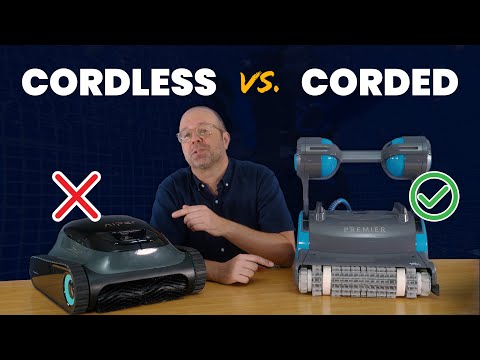
3.1 True Automation vs Daily Interaction
This is where expectations vs reality hit hard. Cordless robots are marketed as “effortless.” And to be fair—dropping one into the pool feels incredibly easy. No cords, no setup, no hassle.
But what happens the next day? You walk outside… The robot is sitting at the bottom. Dead.
Now your routine looks like this:
- Fish it out (usually with a hook or pole)
- Carry a dripping, heavy unit across your yard
- Plug it in
- Wait hours
- Put it back in
Corded robots flip that entire experience. With features like weekly timers, you can literally schedule cleanings in advance. The robot turns on, cleans, and shuts off—without you touching it.
Corded Interaction
- Maybe 1 interaction per week
- Set-and-forget scheduling
Cordless Interaction
- 10–14 interactions per week
- Manual retrieval and recharging
True convenience isn’t about how easy it is to start. It’s about how often you don’t have to think about it at all.
4. Which One Fits Your Pool? Matching Cleaner Type to Real Scenarios
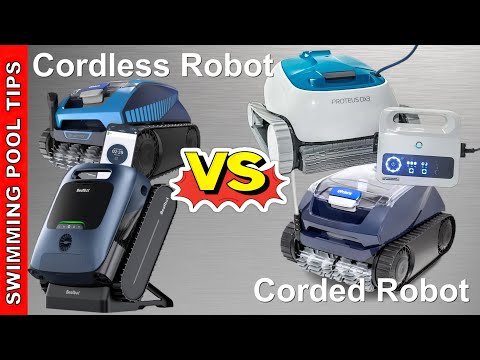
4.1 Small vs Large Pools: Why Size Changes Everything
Pool size isn’t just a detail—it’s the decision.
If you’ve got a compact above-ground pool or a smaller in-ground setup, cordless cleaners can feel like a dream. Drop it in, press a button, and within a couple of hours, most of the visible debris is gone. No cables, no setup friction. For pools under roughly mid-size ranges, that convenience often outweighs the performance trade-offs.
But scale changes everything.
Once you’re dealing with larger in-ground pools—longer than ~30 ft, deeper ends, steps, slopes—the game shifts fast. These pools demand longer cleaning cycles, stronger suction, and consistent coverage. And this is exactly where cordless models start to struggle.
Corded robots don’t have this problem. Unlimited runtime means they can methodically clean the entire pool—floor, walls, and waterline—without compromise.
So the rule is simple:
- Small pool → cordless feels effortless
- Large pool → corded becomes essential
Choose wrong here, and you won’t just lose performance—you’ll gain a recurring frustration.
4.2 Light Dust vs Heavy Leaves: Debris Type Matters More Than You Think
Here’s a mistake a lot of pool owners make: they focus on pool size, but ignore what actually falls into the water.
If your pool mostly deals with fine dust, pollen, or light debris, cordless cleaners can handle the job reasonably well. Their mesh filters and moderate suction are enough to keep things looking clean—at least on the surface.
But now imagine this instead:
- Trees nearby
- Leaves piling up after a windy day
- Gritty sand settling into corners
- Early algae clinging to walls
This is where things get frustrating fast.
Lower suction cordless units often push debris around rather than fully removing it. Larger leaves may clog faster. Fine particles slip through standard mesh filters. And suddenly, you’re running multiple cycles just to get close to clean.
That’s why many experts emphasize that high-flow suction combined with proper filtration is what actually determines whether your pool stays clear or slowly turns cloudy again.
Is your pool mostly “light maintenance”… Or a constant battle against nature? Your answer should decide the machine—not the marketing.
4.3 Cleaning Frequency: Occasional Use vs Daily Maintenance
Let’s talk about how often you actually plan to clean your pool—because this changes everything.
If you’re the kind of owner who runs a cleaner occasionally (say, once or twice a week before guests come over), cordless models can work. They’re quick to deploy, easy to store, and perfect for those “quick refresh” moments.
But if your goal is consistently clean water with minimal effort, the equation flips.
Cordless cleaners require frequent interaction:
- Charge before use
- Deploy manually
- Retrieve after each cycle
- Repeat the next day
Even if each step feels small, it adds up. Fast.
Corded cleaners, on the other hand, are built for routine automation. With scheduled cleaning cycles, they quietly maintain your pool in the background—like a dishwasher that just runs when it needs to.
Occasional Cleaning
- Cordless feels convenient
- Quick deployment
Ongoing Maintenance
- Corded feels invisible
- Hands-off automation
If your goal is to stop thinking about pool cleaning altogether, only one of these options actually delivers that experience.
5. Cost, Durability & Safety: The Long-Term Ownership Reality
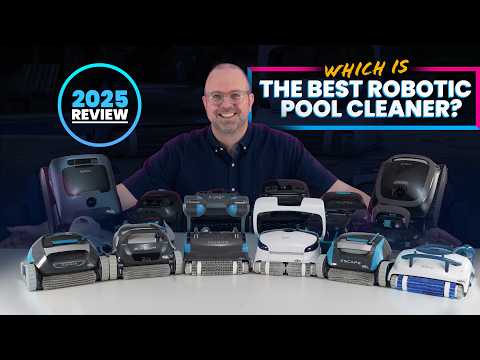
5.1 Upfront Price vs Total Cost of Ownership
At first glance, cordless robots often look like the better deal.
Many models come in slightly cheaper, and the promise of “no cords, no hassle” feels like a win. But here’s the catch: what you save upfront can quietly disappear over time.
Cordless cleaners rely on lithium-ion batteries. And like any battery, they degrade. Typically within 2–3 years, you’ll notice shorter runtimes, weaker performance, and eventually the need for replacement—which can add a few hundred dollars to your ownership cost.
Corded models skip this entirely. No battery. No degradation. Just consistent performance year after year.
| Robot Type | 5-Year Financial Outlook |
|---|---|
| Cordless | Lower entry cost, higher maintenance (battery replacement) |
| Corded | Higher upfront, lower long-term cost (no battery degradation) |
And it’s not just about money—it’s about predictability. Corded cleaners don’t slowly lose performance. They just keep working.
So the real question isn’t “What does it cost today?”
It’s: What will it cost to keep your pool clean for the next five summers?
5.2 Lifespan & Build Quality: 3 Years vs 10 Years?
Let’s be honest—no one wants to replace a pool robot every few years.
Corded cleaners are built differently. Larger motors, fewer battery-related limitations, and more mature engineering all contribute to longer lifespans. It’s common to see well-maintained corded units lasting 7–10 years or more.
Cordless models? Typically 3–5 years, largely limited by battery health.
And the difference shows up in daily use. A corded robot on year five still runs like it did on day one. A cordless unit at the same point? Often shorter runtime, weaker suction, and more frequent interruptions.
5.3 Safety Considerations: Battery Risks vs Corded Stability
Safety isn’t the most exciting topic—but it’s one worth addressing honestly.
Cordless cleaners eliminate external power cords, which many homeowners see as a plus—especially around kids or busy pool areas. No cables on the deck, no tripping hazards.
But they introduce something else: lithium-ion batteries.
There have been documented cases of overheating and even recalls involving certain cordless models. While these incidents are not the norm, they highlight a real consideration—charging and storing battery-powered devices always carries some level of risk.
Corded cleaners take a different approach. They use low-voltage, insulated power systems designed specifically for water environments. No onboard batteries. No charging cycles. No thermal concerns.
Cordless Safety
- No deck cable / tripping hazards
Corded Safety
- Stable, proven electrical systems
- No lithium-ion battery fire risks
For most users, both are safe when used correctly. But if you’re the type who prefers simpler, more predictable systems, corded has the edge.
6. Conclusion: Should You Choose Cordless or Corded?
So—corded or cordless?
It really comes down to one thing: what kind of pool owner you are.
If you want effortless setup, lightweight handling, and quick cleanups for a smaller or lightly used pool, cordless models deliver a smooth, low-friction experience. Drop it in, let it run, and you’re done.
But if your priority is deep cleaning, full coverage, and true hands-off automation, corded cleaners are still in a different league. Stronger suction, unlimited runtime, and set-it-and-forget-it scheduling mean less work—and better results—over time.
There’s no universal winner here.
Just the right tool for your pool, your routine, and how much time you’re willing to spend maintaining both.
FAQ
Q: Is suction power significantly different between corded and cordless models?
A: Yes. Data indicates corded models typically operate between 4,000 to 5,000+ GPH, whereas cordless units often range from 1,200 to 3,000 GPH. This higher flow rate in corded units is essential for deep cleaning and pulling debris through fine filtration systems effectively.
Q: Which type of pool cleaner is better for larger in-ground pools?
A: Corded cleaners are generally recommended for larger pools. Because they have an unlimited power supply, they can complete full cleaning cycles—including floors, walls, and waterlines—without the risk of the battery dying mid-job, which is a common limitation for cordless models.
Q: Do cordless robotic pool cleaners require more maintenance?
A: While they lack cables, cordless cleaners require more frequent physical interaction. Users must daily retrieve the unit from the pool bottom, carry it to a power source, and recharge it, whereas corded models often feature weekly timers for automated, hands-off operation.
Q: How long do the batteries last in cordless pool robots?
A: Most lithium-ion batteries in cordless cleaners have a functional lifespan of 2 to 3 years before performance degrades. In contrast, corded models do not rely on batteries, often resulting in a longer overall machine lifespan of 7 to 10 years.
Q: Can cordless robots handle fine debris and algae?
A: It is challenging. Fine debris requires dense filtration and high suction to move water through the filters. Cordless units often use basic mesh filters because their motors lack the sustained power to push water through ultra-fine nano-filters effectively.