
Hayward TigerShark vs. SharkVac: Data-Driven Breakdown of Cleaning Performance, Features & Value
Aaron Cooper1. Introduction
Choosing a robotic pool cleaner sounds simple—until you’re staring at cloudy water, debris stuck along the waterline, and a machine that somehow missed half the pool. That’s where the Hayward TigerShark vs. SharkVac debate gets real.
In this breakdown, we’ll cut through marketing noise and focus on what actually matters: coverage, cycle time, filtration, navigation, and long-term usability.
2. Cleaning Coverage & Real-World Performance: Which One Actually Cleans Better?
2.1 Floor, Walls, and Waterline: Coverage Differences That Matter
Let’s start with the frustration everyone knows: your pool looks clean… until you notice that greasy ring hugging the waterline or debris stuck halfway up the wall. That’s where coverage becomes the make-or-break factor.
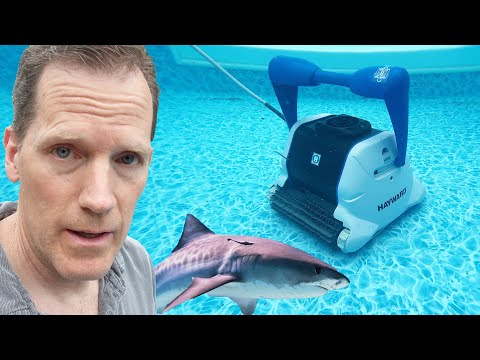
The Hayward TigerShark is built for full coverage—floor, walls, coves, and waterline in a single cycle. It doesn’t just roam the bottom; it actively climbs and scrubs every vertical surface. In real-world terms, that means fewer “missed zones” and no need to go back with a manual brush.
The standard SharkVac, on the other hand, is more selective. It handles the floor extremely well and reaches the coves (those curved transitions), but stops short of true wall and waterline cleaning. That’s fine for shallow pools or light maintenance—but if oils, sunscreen, and fine debris collect at the top edge, you’ll still be scrubbing.
There’s a twist, though. The SharkVac XL closes that gap, offering full wall and waterline cleaning similar to TigerShark. In fact, models like the XL are recognized for cleaning both the pool floor and walls while operating independently, making them a middle-ground option.
So the real question isn’t “which is better?” It’s: do you want complete coverage—or just enough to keep the floor spotless?
2.2 Cycle Time vs Cleaning Depth: Fast vs Thorough Cleaning
Time matters—especially when you just want a clean pool before guests arrive. But here’s the catch: faster isn’t always better.
The SharkVac runs a straightforward 2-hour cycle. It’s quick, predictable, and ideal for routine cleaning. Drop it in, come back later, and your pool floor is clean. Simple.
The TigerShark takes a more thorough approach. Standard cycles run closer to 3–4 hours, covering every inch from floor to waterline. It’s slower—but that extra time translates into deeper, more complete cleaning.
And then there’s the wildcard: TigerShark QC. Its 90-minute Quick Clean mode is designed for those “I need it clean now” moments. It focuses on the floor only, skipping walls to save time. Think of it like a daily maintenance run versus a full deep-clean cycle.
Here’s how it plays out in real life:
- Busy weekday? Quick Clean gets the job done fast.
- Post-storm debris everywhere? Full TigerShark cycle wins.
- Light dirt, shallow pool? SharkVac’s 2-hour cycle is perfectly adequate.
So you’re not just choosing a cleaner—you’re choosing your cleaning rhythm. Fast and focused, or slower and complete.
2.3 Navigation Intelligence: Smart Patterns vs Practical Efficiency
Ever watched a cheap pool cleaner bounce around randomly, missing obvious spots? That’s exactly what better navigation systems are designed to fix.
The TigerShark uses microprocessor-based navigation—basically a built-in “brain” that maps movement and adjusts direction. Instead of wandering, it moves forward, backward, and sideways along walls to find the most efficient cleaning path. The result feels deliberate, almost like it “knows” your pool.
The SharkVac also uses smart steering, guiding itself in calculated patterns rather than random loops. It’s efficient—especially for floor cleaning—but slightly less aggressive when it comes to full vertical coverage.
In practice, both systems avoid the chaos of older robotic cleaners. But the difference shows up over time:
- TigerShark = more systematic, better for complex or deep pools
- SharkVac = efficient and straightforward, ideal for simpler layouts
3. Filtration, Debris Handling & Maintenance Effort
3.1 5-Micron Filtration: одинаковая мощность очистки воды
Here’s something most people overlook: your robotic cleaner isn’t just picking up debris—it’s actively filtering your water.
Both the TigerShark and SharkVac use cartridge filters capable of trapping particles down to 5 microns. That’s fine enough to catch sand, algae, and the cloudy stuff that makes your pool look dull even after a “clean.”
In fact, across independent specs and product documentation, both models operate like self-contained filtration systems moving 70–80 gallons per minute. That’s not just cleaning—it’s circulating and polishing your water at the same time.
What does that feel like in real life?
You run a cycle, come back a few hours later, and the water doesn’t just look cleaner—it looks clearer. Less haze. Less floating debris. Less strain on your main pool filter.
3.2 Top-Access Filters: Which One Is Easier to Maintain?
Now let’s talk about the least glamorous part: cleaning the cleaner.
If you’ve ever had to flip over a dripping, debris-filled robot just to access the filter, you know how annoying that can be. Thankfully, both TigerShark and SharkVac avoid that completely.
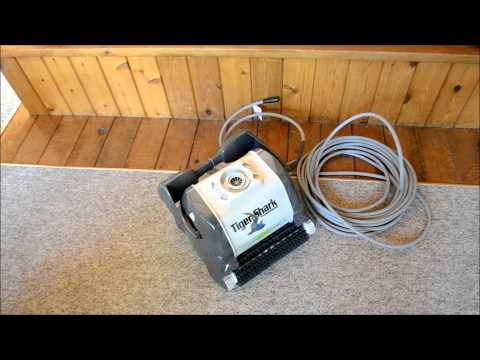
They use top-access cartridge filters. Pop open the lid, lift the cartridges out, and rinse them with a garden hose. Done in under a minute.
Pros
- No flipping the unit over
- No mess spilling back into the pool
- No complicated disassembly required
Cons
- Cartridges must be rinsed thoroughly to maintain 5-micron efficiency
That small design choice makes a huge difference over time. Because let’s be honest—if maintenance is annoying, you’ll delay it. And when you delay it, performance drops.
Both models keep that friction low. It’s quick, simple, and painless. Zero hassle. Zero excuses.
4. Features & Usability: Quick Clean, Plug-and-Play, and Smart Behavior
4.1 TigerShark Quick Clean vs Standard Operation Modes
There’s a very specific kind of frustration every pool owner knows: you don’t need a full deep clean—you just need the pool to look good right now. Maybe guests are coming. Maybe a storm just passed. Either way, waiting hours feels like overkill.
This is where the TigerShark QC separates itself.
Its standout feature is the 90-minute Quick Clean cycle, designed for fast, floor-focused cleaning. Instead of climbing walls and scrubbing every inch, it zeroes in on the areas that get dirty fastest—the pool floor where debris settles. The result? A noticeably cleaner pool in a fraction of the time.
But here’s the key: it doesn’t replace the full cycle. When you switch back to standard mode (around 3–4 hours), the TigerShark goes all-in—walls, coves, waterline, everything.
So you’re not choosing between speed or thoroughness. You’re choosing when you want each.
SharkVac, by comparison, keeps things simple. One cycle. About 2 hours. No modes to think about.
That simplicity is great—until you want flexibility. Because sometimes, fast matters more than perfect. And sometimes, you want both.
4.2 Plug-and-Play Simplicity vs Feature Depth
Let’s be honest—nobody wants to “learn” their pool cleaner.
The beauty of both TigerShark and SharkVac is how refreshingly simple they are. No hoses. No booster pumps. No complicated setup. You literally drop it in, plug it in, and walk away.
"That plug-and-play experience is what makes robotic cleaners so addictive. Once you’ve used one, going back to manual vacuuming feels like washing dishes by hand after owning a dishwasher."
But here’s where the difference shows up.
TigerShark leans slightly toward flexibility. Depending on the model, you get options like selectable cleaning modes and scheduled cycles (think every 24, 48, or 72 hours). It’s still simple—but with just enough control to fit your routine.
SharkVac is even more stripped down. One-button operation. Fixed cycle. No scheduling complexity.
That’s great if you want zero decisions. But limiting if your pool usage changes week to week.
So the real question becomes: do you want a “set it and forget it” box—or something that adapts to your schedule?
4.3 Energy Efficiency and Operation Independence
Here’s something most people don’t realize until after they switch: robotic cleaners don’t just save time—they quietly save your pool system from extra work.
Traditional suction or pressure cleaners rely on your pool pump. That means more strain, more energy use, and more wear over time.
TigerShark and SharkVac? Completely independent.
They run on their own internal systems, circulating water and capturing debris without touching your main filtration setup. In fact, they act like a secondary cleaning system—scrubbing surfaces while simultaneously filtering water.
The impact is subtle but powerful:
- Your main filter doesn’t clog as quickly
- You backwash less often
- Energy consumption stays lower compared to pressure-side systems
And in models like the SharkVac XL, efficiency is taken even further, with reports of dramatically reduced energy usage compared to traditional cleaners.
So while you’re enjoying a clean pool, your equipment is quietly getting a break.
Less strain. Less maintenance. Less cost over time.
5. Price, Warranty & Value: Which One Is Worth Your Money?
5.1 Upfront Cost vs Features: $949 vs $1,199+
Let’s talk about the moment that actually decides everything: the price tag.
At first glance, the SharkVac sits comfortably around $949, while the TigerShark QC typically lands around $1,199 or more. That’s roughly a $250 gap.
So what are you really paying for?
| Model | Price Range | Key Strength | Trade-Off |
|---|---|---|---|
| SharkVac | ~$949 | Affordable, simple, fast floor cleaning | Limited wall/waterline coverage |
| TigerShark QC | ~$1,199+ | Full coverage + Quick Clean flexibility | Higher upfront cost |
That extra cost with TigerShark isn’t just branding—it’s capability. You’re getting full pool coverage and the flexibility of switching between deep cleaning and quick maintenance.
But here’s the honest truth: if your pool is shallow, or you don’t care about waterline scrubbing, SharkVac already does the job extremely well.
So the decision isn’t “cheap vs expensive.”
It’s: are you paying to eliminate every bit of manual cleanup—or just most of it?
5.2 Warranty and Durability Expectations
A pool cleaner isn’t a gadget—it’s a long-term workhorse. And nothing kills that excitement faster than something breaking mid-season.
Across available data, Hayward models typically range from 1-year warranties on entry-level units like SharkVac, up to 2–3 years on higher-end versions like TigerShark QC or SharkVac XL.
That difference matters.
Longer warranties usually reflect more robust build quality and longer expected lifespan. And across industry feedback, Hayward cleaners are consistently positioned as durable, long-lasting machines designed to handle regular use without constant repairs.
TigerShark QC
- Longer coverage (up to 3 years)
- Better suited for heavy or frequent cleaning
SharkVac
- Solid, reliable performance
- More entry-level warranty protection
If your pool sees a lot of debris—or you run cleaning cycles multiple times a week—that extra warranty isn’t just peace of mind. It’s practical.
5.3 Best Value by Pool Type: Shallow vs Deep, Simple vs Demanding
Here’s where everything clicks.
Because the “best” cleaner isn’t universal—it depends entirely on your pool.
If you have a smaller or shallow pool, with minimal debris and no obsession over perfectly clean walls, SharkVac makes a lot of sense. It’s fast, simple, and handles floor cleaning with very little effort.
If your pool is deeper, gets heavy use, or constantly builds up grime along the walls and waterline, TigerShark becomes the obvious choice. It’s built for full coverage and doesn’t leave cleanup behind.
And then there’s the middle ground: SharkVac XL.
It combines full coverage (like TigerShark) with a slightly more approachable price and features like smart navigation and shallow-water sensors—making it a strong compromise for many homeowners.
So instead of asking “which is better,” ask this:
- Do I want basic maintenance → SharkVac
- Do I want zero missed spots → TigerShark
- Do I want balance → SharkVac XL
Pick based on your pool—not the spec sheet.
6. Conclusion: TigerShark vs SharkVac—Which Should You Choose?
At the end of the day, this isn’t a battle of “good vs bad.” It’s a choice between two different cleaning philosophies.
The SharkVac is all about simplicity and value. Drop it in, let it run for a couple of hours, and your pool floor is clean. For many pool owners—especially with shallow or low-debris pools—that’s more than enough.
The TigerShark, especially the QC version, is built for people who want everything handled. Floor, walls, waterline—done. Plus the flexibility of switching between quick touch-ups and deep cleans.
Either way, you’re buying back your time.
And honestly—that’s the whole point.
FAQ
Q: Does the Hayward SharkVac clean pool walls and the waterline?
A: The standard SharkVac primarily focuses on floor and cove cleaning. If you require full wall and waterline scrubbing, the TigerShark or the SharkVac XL models are better suited for those specific vertical cleaning tasks.
Q: How long is the cleaning cycle for the TigerShark QC?
A: The TigerShark QC offers two modes: a 90-minute Quick Clean cycle for rapid floor-only maintenance and a standard 3 to 4-hour cycle for deep cleaning of the floor, walls, and waterline.
Q: What is the filtration capability of these Hayward robotic cleaners?
A: Both the TigerShark and SharkVac series utilize easy-to-clean, top-access cartridge filters capable of trapping debris and particles down to 5 microns, effectively polishing the pool water during operation.
Q: Do these cleaners require a booster pump?
A: No, both models are fully independent plug-and-play robots. They operate using their own internal motors and filtration systems, meaning they do not put extra strain on your existing pool pump.
Q: Which model is better for a pool with a beach entry?
A: The SharkVac XL is particularly noted for its shallow-water or beach-entry sensor, which allows it to detect when it is leaving the water and reverse automatically, preventing it from getting stuck.