
Polaris P825 Suction Power Review: Aggregated Buyer Feedback on Real-World Cleaning Performance
Aaron Cooper1. Introduction: What Real Buyers Reveal About Polaris P825 Suction Power
Suction power sounds like a spec-sheet detail—until you’re the one staring at a pool floor still covered in sand after a “full” cleaning cycle. That’s where real-world feedback matters more than marketing claims.
This deep dive into the Polaris P825 isn’t about theoretical performance. It’s built on aggregated buyer experiences—what actually happens when this robot is dropped into pools full of leaves, dirt, and post-storm mess. Across hundreds of reviews and field reports, a few themes keep surfacing: strong debris pickup across sizes, surprisingly stable suction mid-cycle, and a few edge-case limitations depending on pool conditions.
"So, does it really clean like you hope it will—or just “kind of”? Let’s break it down where it matters most: real debris, real pools, real expectations."
2. Real-World Suction Performance: How Well Does the Polaris P825 Actually Clean?

2.1 Handling Fine Debris Like Sand and Dirt
Fine debris is where most robotic cleaners quietly fail. Sand, silt, and that annoying dusty layer? They don’t just sit on the surface—they cling, settle, and slip past weak suction systems.
This is where the Polaris P825 consistently earns its keep.
Across aggregated buyer feedback, a clear pattern emerges: during standard cleaning cycles (around 1.5 hours), the P825 reliably lifts fine sand and small particulate debris without losing momentum mid-run. Users frequently describe a “set it and forget it” experience—no need to rerun cycles just to chase leftover grit.
What’s happening behind the scenes? The suction doesn’t taper off halfway through the job. Even as debris accumulates, the system keeps pulling consistently, so you don’t get that frustrating “clean at first, lazy at the end” behavior.
If your current cleaner leaves behind that thin, dusty layer, this alone can feel like a massive upgrade.
2.2 Performance with Leaves, Pine Needles, and Larger Debris
Now let’s talk about the stuff that really tests a cleaner—leaves after a windy day, pine needles after a storm, and the random debris that seems to appear overnight.
Here’s the good news: the Polaris P825 doesn’t choke under pressure.
Real-world usage shows it handling everything from small leaves to heavier debris loads with surprising ease. In one commonly reported scenario, users ran extended cleaning cycles (around 2–2.5 hours) after storms dumped pine needles into the pool—and the robot still completed the job effectively.
A big reason? Its design. The combination of dual brushes and an oversized intake allows it to grab bulkier debris in fewer passes. Instead of nudging leaves around (which cheaper robots tend to do), it actually captures them.
- Capable of handling any kind of debris from fine to large.
- Dual-brush system for active scrubbing and debris capture.
- Effective in typical residential pool environments.
2.3 Does Suction Stay Strong Throughout the Cleaning Cycle?
Here’s the deal-breaker question most buyers don’t think to ask: Does the cleaner still have power at the end of the cycle—or is it just going through the motions?
With the Polaris P825, this is where its Cyclonic Vacuum Technology that keeps debris suspended for continuous suction becomes more than just a buzzword.
In simpler terms, instead of debris clogging the filter and choking airflow (a common issue), the system spins and separates particles so suction remains stable. Think of it like the difference between a vacuum that clogs instantly and one that keeps airflow moving no matter what.
Buyer feedback backs this up: suction remains strong even when the filter basket is partially full. That’s a big deal. It means the last 20 minutes of your cleaning cycle are just as effective as the first 20.
3. Is the Polaris P825 Powerful Enough for Your Pool?
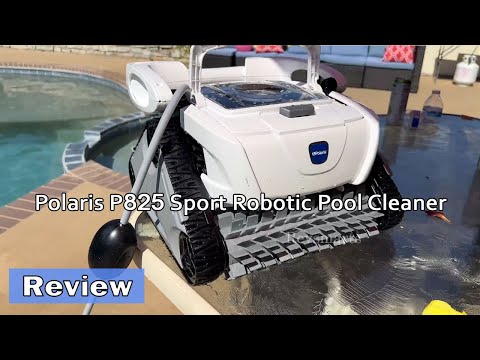
3.1 Performance in Heavy Debris Conditions (Storms, Trees, Seasonal Mess)
If your pool sits under trees, you already know the struggle. One windy afternoon can undo an entire week of cleaning.
This is exactly the kind of environment where the Polaris P825 gets stress-tested—and overall, it holds up well.
Users dealing with constant leaf fall, dirt, and pine needles report that the cleaner performs reliably, especially when switching to longer cleaning cycles. After heavy storms, running a 2–2.5 hour session typically clears out the bulk of debris without requiring manual intervention.
The oversized intake and dual-brush system play a key role here, helping the robot grab debris quickly instead of repeatedly passing over it.
3.2 Fine Particles Like Pollen and Silt: Where It Struggles
Now for the honest part—because no cleaner is perfect.
Pros
- Excellent sand and visible debris pickup.
- Consistent suction performance.
- Durable dual-brush scrubbing.
Cons
- Ultra-fine particles (pollen/silt) can slip through the standard filter.
- May require a filter upgrade for maximum water clarity.
The fix? Upgrading the filter. There are finer mesh filter options available, specifically designed to capture smaller particles. Without that upgrade, you may find yourself wishing for just a bit more polish in water clarity—especially during pollen-heavy seasons.
3.3 Pool Size and Coverage: What to Expect in Larger Pools
The Polaris P825 is designed for in-ground pools up to 40 feet—and within that range, it performs as expected.
But what happens when you push that limit? In larger or more complex pools, buyer feedback reveals a common pattern: one cycle may not achieve full coverage. Some areas—especially around steps or tricky layouts—can be missed on the first pass.
The practical workaround is simple: run a second cycle or schedule regular cleanings. Many users with larger pools already do this, treating the robot like a daily maintenance tool rather than a one-shot solution.
3.4 Maintenance Impact on Suction Performance
Here’s something most people learn the hard way: Even the best suction system fails if you ignore maintenance.
With the P825, the biggest performance killer isn’t weak design—it’s a clogged canister. In fact, manufacturer guidance and user experience both point to this as the number one cause of reduced performance.
When debris builds up (especially fine particles), airflow drops, and suction efficiency follows. The fix is simple but non-negotiable:
- Empty the canister after each cleaning cycle.
- Rinse it thoroughly with a garden hose.
- Occasionally deep-clean the mesh to remove fine residue buildup.
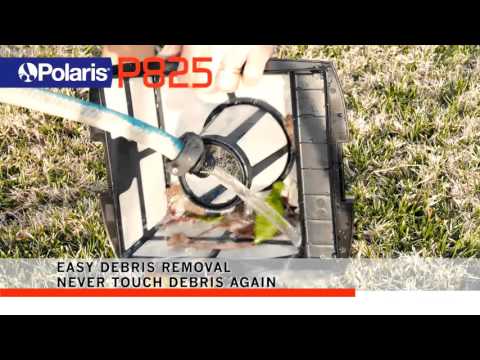
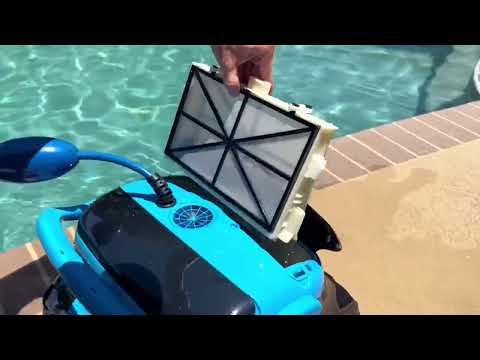
Do that, and the suction stays strong. Skip it, and even a high-performing robot will start to feel underwhelming. The good news? The Push’N’Go top-load canister design makes this process quick and mess-free.
Check Price on Amazon4. What Design Features Actually Influence Suction Performance?
4.1 Cyclonic Vacuum Technology Explained in Simple Terms
Let’s be honest—most pool robots start strong… and then quietly give up halfway through the job.
You’ve probably seen it: the first 20 minutes look great, but by the end, it’s just gliding over debris like it’s tired.
The Polaris P825 tackles this with its cyclonic vacuum system—but what does that actually mean?
This isn’t just theory. Aggregated buyer feedback consistently highlights that suction stays strong even as the canister fills, which is exactly where traditional systems tend to fail.
The result feels subtle but powerful: the cleaner doesn’t “fade.” It finishes just as strong as it started.
No drop-off. No half-clean pools. Just consistent performance from start to finish.
4.2 Dual Brush System and Debris Channeling Efficiency
Here’s something most people overlook: suction alone doesn’t clean your pool.
If debris isn’t properly lifted and guided into the intake, even strong suction won’t save you. That’s where the P825’s dual brush system quietly does a lot of heavy lifting.
Instead of relying on a single brush pass, it uses a front-and-rear brush setup. The front brush loosens debris—think stuck dirt, sand, or leaves clinging to the pool floor. Then, as the robot moves forward, the rear brush follows up and pushes everything directly into the suction path.
It’s a one-two punch.
In real-world terms, this reduces that annoying behavior where debris gets pushed around instead of picked up. You know the one—leaves drifting just out of reach, over and over again.
- Loosen: Front brushes agitate stubborn grime.
- Guide: Mechanical action directs debris toward the center.
- Capture: Suction pulls it into the cyclonic chamber.
And you feel the difference. Fewer missed particles. Fewer repeat passes. Less babysitting.
4.3 Oversized Intake and Why It Matters for Large Debris
Ever watched a pool robot bump into a leaf… and just shove it somewhere else?
That’s usually an intake problem.
The Polaris P825 addresses this with an enlarged intake opening designed to handle bulkier debris in a single pass. Instead of requiring multiple attempts to “line up” debris just right, it simply swallows more on contact.
This becomes a game-changer after storms or in pools surrounded by trees. Sticks, clusters of leaves, even heavier debris loads—these are exactly the situations where smaller intakes struggle.
According to comparative analysis, the P825’s oversized intake design that improves large-debris capture per pass gives it a noticeable edge in these conditions.
Bottom line? Bigger intake, fewer passes, faster cleanup. And when you’re staring at a messy pool, that’s all you really care about.
5. Polaris P825 vs Similar Pool Robots: Suction Performance in Context
If you’re trying to compare suction power across pool robots, here’s the frustrating truth:
There are no standardized suction ratings.
No universal “Pa” number. No easy side-by-side spec. So instead, you have to look at what actually affects cleaning in the real world—design, behavior, and user outcomes.
| Feature | Polaris P825 | Polaris 8050 Sport | Dolphin Models (General) |
|---|---|---|---|
| Vacuum System | Cyclonic Vacuum Technology | Cyclonic Vacuum Technology | Brand-specific systems |
| Brush Setup | Dual front + rear brushes | Dual brushes | Dual or multiple brushes |
| Intake Design | Oversized intake | Standard intake | Varies by model |
| Debris Handling | Fine to large debris | Similar, slightly less aggressive | Strong overall |
| Pool Coverage | Floor, walls, waterline | Floor, walls, waterline | Model-dependent |
So what actually matters here?
- P825 vs Polaris 8050: Both use cyclonic suction, so raw suction consistency is similar. The difference comes down to mechanics. The P825’s dual active brushes and larger intake give it an edge when dealing with heavier debris loads.
- P825 vs Dolphin cleaners: Dolphin models often compete on navigation and smart features, but the P825 stands out more in mixed debris scenarios, especially when larger debris is involved.
Now, the honest limitation: there’s no hard lab data comparing suction force across these models. Everything comes back to design choices and real-world feedback.
And that feedback consistently paints the P825 as a workhorse—particularly in pools where debris isn’t just light dust, but a mix of everything.
6. Conclusion: Should You Trust the Polaris P825’s Suction Power?
So, is the Polaris P825 actually as powerful as buyers claim?
Based on aggregated real-world feedback, the answer is yes—with a few important caveats.
Pros
- Consistent cyclonic suction cycle-long
- Handles mixed debris (fine sand to large leaves)
- Oversized intake prevents "shoving" debris
Cons
- Ultra-fine pollen may need filter upgrade
- Large pools may need multiple cycles
Still, for most pool owners—especially those dealing with mixed debris and regular mess—the P825 hits a sweet spot: powerful, reliable, and low-maintenance when used correctly.
FAQ
Q: Does the Polaris P825 lose suction when the canister is nearly full?
A: Based on aggregated data and its cyclonic vacuum design, the P825 is engineered to keep debris suspended. This allows it to maintain relatively stable suction and airflow even as the filter canister accumulates debris during a cleaning cycle.
Q: Can the Polaris P825 handle large leaves and pine needles?
A: Yes, the model features an oversized intake and dual-brush system specifically designed to capture bulkier debris. User feedback indicates it performs well after storms, though the canister may require more frequent emptying during heavy debris seasons.
Q: Is the Polaris P825 effective against fine silt and pollen?
A: While the standard filter handles sand well, very fine particles like silt or pollen can sometimes pass through. For pools prone to fine dust, upgrading to a fine-mesh filter canister is recommended to improve overall water clarity.
Q: How does the cyclonic suction technology work?
A: It creates a spinning vortex inside the canister that prevents debris from sticking to and clogging the filter walls. By keeping the filter surface clear, the robot maintains consistent water flow and cleaning power until the cycle ends.
Q: Does the Polaris P825 cover the entire pool in one pass?
A: In pools up to 40 feet, it typically provides good coverage of the floor and walls. However, in complex pool shapes or larger layouts, users suggest running a second cycle to ensure every corner and step is reached.