
LiDAR vs. VSLAM Navigation: Data-Driven Performance Comparison for Robot Vacuums in Real Homes
Aaron Cooper1. Introduction
If you’ve ever watched your robot vacuum zigzag randomly, miss a corner, then awkwardly bump the same chair leg three times… you already know this: navigation is everything.
Modern robot vacuums don’t just “clean”—they map, plan, and optimize. And at the center of that intelligence is one critical choice: LiDAR vs. vSLAM navigation. This isn’t just a spec-sheet detail. It directly affects whether your floors get cleaned in one smooth pass—or turn into a frustrating game of robotic pinball.
2. LiDAR vs. vSLAM Explained: How These Navigation Systems Actually Work

2.1 LiDAR Navigation: Laser-Based Precision and Geometry Mapping
Let’s start with LiDAR—short for Light Detection and Ranging. Sounds technical, but the idea is surprisingly intuitive.
Imagine your robot standing in the middle of your living room, spinning and firing invisible laser pulses in all directions. Each pulse bounces off walls, furniture, and obstacles, then returns to the sensor. By measuring how long that round trip takes (called Time-of-Flight), the robot calculates exact distances and builds a detailed geometric map of your home.
This process happens continuously, creating what engineers call a “point cloud”—basically a dense outline of your space. Combined with SLAM (Simultaneous Localization and Mapping)—which means the robot builds the map while tracking its own position—it can clean in structured, predictable paths.
Instead of wandering aimlessly, a LiDAR robot moves in clean, parallel lines. It knows where it’s been. It knows what’s left. And it doesn’t second-guess itself every time the lighting changes or a chair moves slightly.
The result is consistency. Day after day, it follows nearly identical routes, refining the map instead of reinventing it. That’s why LiDAR systems are widely described as “precise and stable” for home mapping, especially in larger or more complex layouts.
2.2 vSLAM Navigation: Camera-Based Mapping and Visual Landmark Tracking
Now let’s switch to vSLAM—Visual Simultaneous Localization and Mapping.
Instead of lasers, vSLAM relies on cameras. Your robot is essentially “looking” at your home and trying to understand it the way a human would—by recognizing visual features like edges, corners, furniture outlines, and textures.
Here’s how it works in practice:
- The camera captures continuous images as the robot moves
- Algorithms detect unique visual landmarks (like table legs or wall edges)
- The system tracks how those features shift between frames
- From that, it estimates position and builds a map
It’s clever. And when conditions are right—good lighting, plenty of visual detail—it works surprisingly well.
- Dim lighting? Fewer visible features
- Plain white walls? Harder to track position
- Shadows or reflections? Potential confusion
In a bright, well-furnished apartment, a vSLAM robot can navigate smoothly. But take that same robot into a dim hallway at night, and suddenly it’s hesitating, slowing down, or drifting off course.
2.3 From Algorithms to Cleaning Results: Why SLAM Differences Matter at Home
All of this tech talk is interesting—but what actually matters is what happens on your floors.
Here’s where the differences hit you. Picture a typical Saturday morning clean:
- Chairs slightly moved from yesterday
- A pair of shoes left near the hallway
- Maybe a pet wandering through
A LiDAR-based robot handles this like a calm, methodical planner. Its map is geometry-based and stable, so small changes don’t throw it off. It adjusts paths, avoids obstacles, and keeps going without losing track of the bigger picture.
A vSLAM robot? It can adapt—but it relies on visual consistency. Change the lighting, move key landmarks, or reduce visual detail, and it may hesitate or take less efficient routes.
3. Data-Driven Performance Comparison: Accuracy, Efficiency, and Reliability
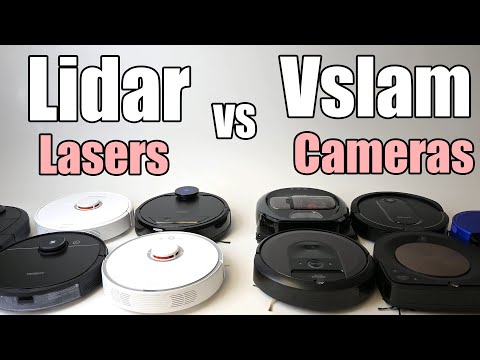
3.1 Mapping Accuracy and Consistency: Centimeter Precision vs. Visual Drift
Let’s talk precision—because this is where the gap becomes hard to ignore.
Across multiple independent comparisons, LiDAR systems consistently achieve around 1–2 cm mapping precision, while vSLAM systems typically show 5–10 cm positional variance. That might sound small on paper, but in your home, it’s the difference between:
- Clean, straight edges vs. slightly missed strips
- Accurate no-go zones vs. “almost right” boundaries
- Stable maps vs. gradual drift over time
With LiDAR, your robot builds a geometry-based map that stays consistent across runs. You can divide rooms, set virtual walls, and trust that those boundaries won’t shift tomorrow.
3.2 Coverage Efficiency and Cleaning Speed: Straight Lines vs. Meandering Paths
Now imagine two robots cleaning the exact same home. One moves like it’s mowing a lawn—straight, parallel lines, minimal overlap. The other takes a more “exploratory” approach, occasionally doubling back or adjusting mid-path.
| Metric | LiDAR Navigation | vSLAM Navigation |
|---|---|---|
| Mapping Time | ~20–30 minutes | ~45–60 minutes |
| Path Planning | Structured parallel lines | More complex, exploratory |
| Efficiency | High (Minimal overlap) | Moderate (Occasional re-cleaning) |
You feel this most in larger homes. What should be a quick, one-pass clean can turn into a longer session with more battery usage.
3.3 Obstacle Handling in Real Homes: Furniture, Clutter, and Dynamic Obstacles
Here’s where things get a bit more nuanced. A lot of people assume LiDAR vs. vSLAM determines obstacle avoidance. Not entirely true.
LiDAR Strengths
- Excellent at structural geometry (walls, large furniture)
- Highly reliable collision avoidance in low light
vSLAM Strengths
- Better visual context for object recognition
- Potential to "see" textures and shapes
Where both struggle? Small, low-lying clutter like cables, socks, and pet toys. Navigation tech determines how the robot moves through space. Obstacle avoidance depends more on sensor fusion and AI, not just LiDAR vs. vSLAM alone.
3.4 Lighting and Environmental Reliability: Day, Night, and Everything In Between
This is the deal-breaker for many households. LiDAR is an active sensor—it emits its own laser light. That means:
- Pitch dark room? No problem
- Night cleaning schedule? Works perfectly
- Curtains closed? No impact
vSLAM, on the other hand, depends on what the camera can see. According to multiple sources, it can struggle when lighting is dim, shadows are strong, or surfaces lack visual features.
LiDAR doesn’t care what time it is. vSLAM definitely does.
4. Cost vs. Performance: Is LiDAR Worth the Premium?

4.1 Upfront Cost Differences and What You Actually Pay For
Let’s address the elephant in the room: price.
LiDAR robots almost always sit in the mid-to-high-end tier, while vSLAM models are typically more budget-friendly. That’s not marketing fluff—it’s hardware reality. LiDAR systems require laser sensors, rotating modules (in many designs), and more complex mapping components. Cameras, by comparison, are cheaper and easier to integrate.
But here’s where many buyers get tripped up.
You’re not just paying for a sensor. You’re paying for predictability.
A lower-cost vSLAM robot can absolutely clean your home—but if it takes longer routes, misses edges, or struggles at night, that “savings” starts to feel less satisfying over time. Meanwhile, LiDAR robots justify their higher price by delivering consistent, repeatable performance—especially in larger or more complex spaces.
- LiDAR robots are typically taller (that top-mounted sensor has to go somewhere)
- vSLAM robots are slimmer and can slide under lower furniture
So yes—LiDAR costs more. But what you’re really buying is reliability. And for many households, that’s the difference between a gadget you babysit… and one you forget even exists.
4.2 Efficiency, Battery Usage, and Long-Term Value
Now let’s talk about something most spec sheets won’t tell you: how navigation affects long-term ownership.
Picture this.
Two robots, same battery size. One cleans your home in a clean, structured pattern. The other takes a few detours, overlaps slightly, and needs extra time to finish.
Which one do you think puts less strain on its battery over time?
This is where LiDAR quietly pulls ahead. Because of its efficient path planning:
- Cleaning sessions are typically shorter
- There’s less redundant movement
- Fewer mid-clean recharges are needed in larger homes
Even though LiDAR sensors themselves consume power, the overall system often balances out—or even comes out ahead—because the robot simply finishes faster.
LiDAR Long-term Value
- Faster completion times
- Optimized battery cycles
- Precise navigation efficiency
vSLAM Long-term Value
- May run longer per session
- Unintentional redundant coverage
- Variability based on lighting
Over months and years, that difference adds up—not just in electricity, but in battery wear and tear. It’s subtle. But if you’re running your robot daily, it matters.
4.3 When vSLAM Is the Smarter Buy (and When It Isn’t)
Let’s be real: LiDAR isn’t automatically the right choice for everyone.
There are plenty of situations where vSLAM is actually the smarter buy—and pretending otherwise would just waste your money.
- You live in a small apartment with a simple layout
- Your space is consistently well-lit
- You don’t need ultra-precise room segmentation or no-go zones
- Budget is a primary concern
In these environments, the performance gap shrinks dramatically. You’ll still get systematic cleaning, decent coverage, and a much lower upfront cost.
And here’s a big one people overlook: low furniture clearance. If your sofa or bed sits low to the ground, a slimmer vSLAM robot might actually clean more area than a taller LiDAR model that physically can’t fit underneath.
5. Choosing the Right Navigation for Your Home Layout and Lifestyle
5.1 Best for Large, Complex, or Multi-Room Homes
If your home has multiple rooms, long hallways, or an open-plan layout, navigation stops being a convenience—and becomes a necessity.
This is where LiDAR shines. Thanks to its geometric mapping and consistent localization, LiDAR robots handle:
- Room-to-room transitions smoothly without hesitation.
- Narrow corridors without drifting off course or bumping walls.
- Complex layouts without “getting lost” mid-clean.
And the data backs this up. Across independent comparisons, LiDAR systems maintain centimeter-level mapping precision, which means boundaries stay accurate—even after repeated runs.
In real life, that translates to reliable room segmentation in the app, accurate no-go zones that actually stay put, and efficient cleaning paths across large areas.
5.2 Best for Small Apartments and Budget-Conscious Buyers
Now flip the scenario. You’ve got a one-bedroom apartment. Maybe two rooms. Everything is fairly open, well-lit, and easy to navigate.
Do you need LiDAR? Honestly—probably not.
This is where vSLAM hits its sweet spot:
- Lower cost
- Slimmer design
- “Good enough” performance for everyday cleaning
If you’re testing the waters with your first robot vacuum, this can be a smart entry point. Just go in with the right expectations regarding slightly longer cleaning times or minor inconsistencies if lighting changes.
5.3 Cluttered Homes, Pets, and Hybrid Navigation Systems
Now let’s talk about real life—the messy kind. Toys on the floor. Charging cables. Pet bowls.
Here’s the truth: neither LiDAR nor vSLAM alone fully solves this.
| Technology | Core Strength | Blind Spot |
|---|---|---|
| LiDAR | Precise mapping of space/walls | Doesn’t "understand" small objects |
| vSLAM | Visual feature recognition | Heavily dependent on light/clarity |
That’s why the best-performing robots today are hybrid systems. They combine LiDAR for precise, stable mapping and Cameras + AI for object recognition and avoidance.
Instead of just avoiding obstacles, the robot starts to identify them: navigating around cables instead of dragging them, avoiding pet-related hazards, and adapting to cluttered, dynamic environments.
6. Conclusion: LiDAR vs. vSLAM—Which One Should You Choose?
So, which one wins? It depends entirely on your home—and your tolerance for imperfection.
LiDAR is the clear choice if you want accuracy, consistency, and zero drama. It handles large layouts, dark rooms, and daily automation without needing babysitting.
vSLAM, on the other hand, earns its place as the practical option. It’s more affordable, slimmer, and perfectly capable in smaller, well-lit homes where complexity is low.
And then there’s the middle ground: hybrid systems. If you want the best of both worlds—precise mapping plus smarter obstacle handling—they’re hard to beat.
The real question isn’t “which is better?” It’s: what kind of home—and lifestyle—are you trying to automate?
Because the right navigation system doesn’t just clean your floors. It gives you your time back.
Q: Which navigation is best for night cleaning?
A: LiDAR is superior for night cleaning as it uses lasers to "see" in total darkness, whereas vSLAM requires visible light to navigate effectively.
FAQ
Q: Does LiDAR navigation work in total darkness?
A: Yes. Because LiDAR is an active sensor that emits its own laser pulses to measure distances, it does not require external light. This makes LiDAR-based robot vacuums highly reliable for scheduled night cleaning or navigating under dark furniture where camera-based systems often struggle.
Q: Which navigation system is better for large, multi-room homes?
A: LiDAR is generally superior for complex layouts. Data-driven analysis shows it maintains 1–2 cm mapping precision, allowing for more stable room segmentation and efficient path planning without the positional drift often seen in vSLAM systems over long distances.
Q: Why are vSLAM robot vacuums usually shorter than LiDAR models?
A: LiDAR systems typically require a rotating laser turret mounted on top of the robot, adding height. vSLAM systems use cameras integrated into the body, allowing for a slimmer profile that can more easily slide under low-clearance beds and sofas.
Q: Can vSLAM robots recognize obstacles better than LiDAR?
A: While vSLAM provides visual context, standard versions still struggle with small objects. True obstacle recognition usually requires a hybrid system that combines LiDAR for mapping with AI-powered cameras specifically designed to identify items like cables, socks, or pet waste.
Q: Does navigation technology affect battery life?
A: Indirectly, yes. LiDAR systems enable more structured, parallel cleaning paths with minimal overlap. By finishing the cleaning cycle faster and avoiding redundant coverage, LiDAR robots often preserve battery health more effectively than vSLAM models that may take less efficient routes.