
Best Robot Mowers for Steep Hills and Uneven Terrain: Top Picks by Slope, Traction & Real-World Performance
Aaron Cooper1. Introduction
If your lawn looks more like a ski slope than a backyard, you already know the pain. Standard robot mowers promise “hands-free,” but the moment they hit a steep incline, reality kicks in—wheels spin, the machine slides sideways, and you’re left with patchy, uneven cuts (and sometimes torn-up turf).
It’s not just annoying. It’s exhausting.
2. Best Robot Mowers for Steep Hills and Uneven Terrain (Top Models Compared)

2.1 Extreme Slopes (70%–84%): AWD Leaders That Conquer Mountain-Like Terrain
Let’s be honest—once your lawn pushes past ~35% slope, most robot mowers are out of their depth. This is where true AWD machines step in.
Models like the Navimow X4, Mammotion LUBA 3 AWD, and Dreame A3 AWD Pro sit at the very top of the category, designed specifically for terrain that would make a push mower feel dangerous.
Here’s how they compare:
| Model | Max Slope | Drive System | Key Strength |
|---|---|---|---|
| Navimow X4 | 84% (40°) | AWD | Dual suspension + traction control |
| Mammotion LUBA 3 AWD | 80% (38.6°) | AWD | Strong grip + off-road stability |
| Dreame A3 AWD Pro | 80% | AWD | LiDAR + AI vision navigation |
What makes them different isn’t just raw climbing ability—it’s how they stay controlled while doing it.
Take the Navimow X4. Its dual suspension system and balanced weight distribution mean it keeps all four wheels planted even when the ground isn’t. That’s critical, because once a wheel lifts, cheaper mowers lose traction instantly.
The Mammotion LUBA 3 AWD takes a slightly different approach—focused on brute grip and stability. Independent motors on each wheel allow it to keep moving even when conditions are uneven, muddy, or loose. It doesn’t just climb. It pulls itself up.
And then there’s the Dreame A3 AWD Pro, which adds a layer of intelligence. With LiDAR (laser-based 3D mapping) and AI vision, it doesn’t just react to terrain—it anticipates it, adjusting its path before things go wrong.
2.2 Professional & Large Properties: Reliable AWD Systems for Complex Lawns
Now, what if your challenge isn’t just steep slopes—but scale?
Large properties introduce a different kind of frustration: long runtimes, complex layouts, and constant navigation errors. This is where professional-grade machines like the Husqvarna Automower 535 AWD EPOS and Sunseeker Elite X7 shine.
| Model | Max Slope | Coverage Focus | Key Design Advantage |
|---|---|---|---|
| Husqvarna 535 AWD EPOS | 70% | Professional / estates | Articulated body design |
| Sunseeker Elite X7 | 70% | Large residential | Floating dual-disc deck |
The Husqvarna 535 AWD isn’t flashy—it’s engineered. Its articulated body (think of it like a flexible spine) allows the mower to stay balanced as it moves over dips and ridges. Instead of tipping or losing contact, it adapts to the terrain in real time. That’s a big reason it’s widely used in professional environments like golf courses.
The Sunseeker Elite X7, on the other hand, focuses on consistency. Its floating cutting system keeps the blade height stable even when the ground isn’t. So instead of scalping high spots or missing low patches, you get a clean, even cut across the entire lawn.
If your property is large, uneven, and full of obstacles, this is where reliability matters more than peak slope numbers.
2.3 Extreme Terrain Alternative: When Tracked Robot Mowers Outperform Wheels
Even AWD has limits. If your lawn includes mud, loose soil, exposed roots, or seriously steep cross-slopes, wheels—no matter how advanced—can still slip.
| Model | Max Slope | Drive Type | Best For |
|---|---|---|---|
| Lymow One Plus | 45° (100%) | Tracked treads | Mud, loose soil, extreme terrain |
Instead of relying on four contact points like wheels, tracked systems spread the mower’s weight across a continuous surface. The result?
- More grip
- Less sinking
- Better stability on sideways slopes
In fact, tracked designs can handle up to 45° slopes with continuous tread traction, which is beyond what most wheeled systems can reliably achieve.
Pros
- Superior grip on mud and loose soil
- Maximum stability on extreme inclines
- Won't spin out on exposed roots
Cons
- Heavier design
- More complex to maintain
- Less efficient on flat, clean lawns
So when does it make sense? If your yard regularly turns into mud after rain… If you’ve got loose gravel or tree roots… If your mower keeps getting stuck in the same spots… This is where tracks stop being “overkill” and start being the only thing that works.
2.4 Mid-Range & Moderate Slopes: Budget-Friendly Options and Their Limits
Not every lawn is extreme—and not every budget can stretch to AWD flagships.
For moderate slopes (think up to ~45%), rear-wheel drive (RWD) models like the Sunseeker Elite X4 offer a more affordable entry point.
| Model | Max Slope | Drive Type | Best Use Case |
|---|---|---|---|
| Sunseeker Elite X4 | ~45% | RWD | Dry, moderate slopes |
Here’s the reality: these mowers can work well—under the right conditions. RWD designs shift weight toward the rear wheels when climbing, which improves grip going uphill. On dry grass, that’s often enough to get the job done.
- Wet grass → slipping
- Downhill runs → reduced control
- Uneven terrain → inconsistent traction
This is why so many people feel disappointed after buying a “mid-range” mower. It works… until it doesn’t.
If your lawn is mostly dry, moderately sloped, and fairly even—this category is perfectly fine. But if you’re already dealing with slipping, patchy cuts, or frequent rescues, stepping up to AWD isn’t a luxury. It’s a sanity saver.
3. What Features Actually Matter for Hills and Uneven Lawns
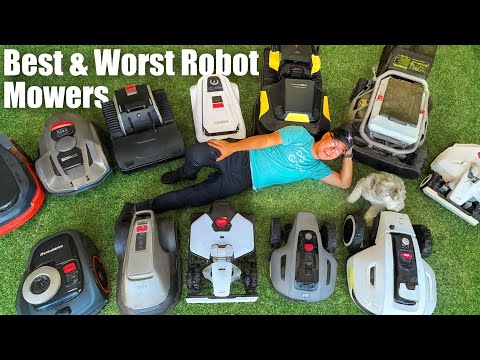
3.1 Drive Systems Explained: AWD vs Tracked vs 2WD (And Why It Matters)
If there’s one decision that determines whether your robot mower thrives or fails on hills—it’s the drive system.
| Drive Type | Typical Slope Capability | Reality Check |
|---|---|---|
| 2WD | Up to ~20% | Slips, spins, struggles |
| AWD | 35%–84% | Best for most hilly lawns |
| Tracked | 45°+ | Extreme terrain only |
2WD sounds fine on paper—until you see it on a slope. With only two powered wheels, it’s like trying to climb a hill in socks. Wheel spin, sliding, and turf damage become routine.
AWD changes everything. By powering all four wheels independently, it keeps traction even when the ground is uneven. If one wheel lifts slightly, the others keep pulling. That’s why AWD has become the standard recommendation for anything beyond gentle slopes.
Tracked systems take it even further. Instead of four points of contact, you get continuous ground contact. That’s why they dominate in mud, loose soil, and extreme inclines.
- Flat lawn: 2WD is fine
- Hilly lawn: AWD is essential
- Harsh terrain: tracks win
3.2 Suspension, Traction & Tires: The Hidden Factors Behind Real Grip
Here’s something most spec sheets won’t tell you: Two mowers with the same slope rating can perform completely differently. Why? Because real-world grip isn’t just about power—it’s about contact.
- Suspension: Models like the Navimow X4 use dual suspension to keep all wheels grounded on bumpy terrain. Without it, traction disappears as wheels lift.
- Tire Design: Deep-tread, off-road tires—like those on the Sunseeker Elite X7—bite into the soil instead of gliding, especially on damp grass.
- Center of Gravity: A low, balanced design keeps the mower “hugging” the ground instead of tipping backward or drifting sideways.
3.3 Navigation Systems: RTK, LiDAR, and AI Vision on Complex Terrain
Climbing a hill is one thing. Climbing it accurately, without getting lost or missing patches? That’s another.
- RTK-GNSS: Uses satellites for centimeter-level accuracy. Precise in open areas.
- LiDAR: Scans environment in 3D using lasers. Works in low light and under tree cover.
- Vision AI: Camera-based. Great for obstacle detection but lighting dependent.
That’s why newer models combine multiple systems. The most reliable setups today use a fusion approach—RTK + vision or LiDAR—so if one fails, the others take over. On a complex, sloped lawn, navigation isn’t optional. It’s survival.
3.4 Battery Performance on Slopes: Why Real Coverage Is Lower Than Advertised
Your mower will not cover the advertised area on a hilly lawn. Not even close.
Real-world data shows that slope mowing can increase power consumption by 40–60%, reducing effective coverage to about 45–55% of the rated capacity.
Climbing slopes requires significantly more power. Motors work harder, traction systems draw more energy, and navigation becomes more computationally demanding.
This is why fast charging and multi-cycle operation matter so much. Premium models compensate by automatically returning to recharge and continuing where they left off. When choosing a mower, don’t just look at coverage specs—think about your terrain. Because on a slope, gravity always wins.
4. Real-World Usability: Setup, Reliability, and Long-Term Ownership
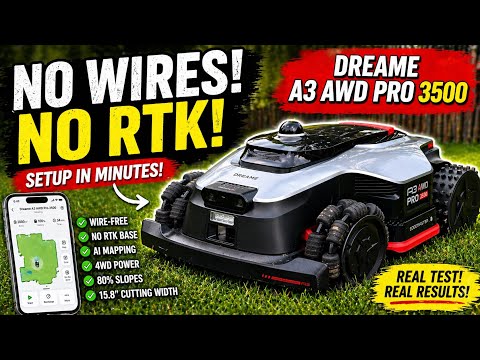
4.1 Wire-Free vs Boundary Wire: Which Setup Works Best on Slopes?
Let’s start with the part nobody enjoys: setup.
If you’ve ever installed a boundary wire on uneven terrain, you already know—it’s a weekend-killer. Hammering stakes into sloped ground, rerouting around rocks, fixing breaks after heavy rain… it’s not just tedious, it’s fragile.
That’s why wire-free systems (typically RTK-based) feel like such a leap forward.
Instead of burying cables, you map your lawn digitally using an app. Walk the perimeter once, set no-go zones, and you’re done. On complex, sloped properties, this flexibility is huge. Need to block off a muddy patch after rain? Just redraw a zone—no digging required.
That’s why many newer models combine RTK with vision or radar—to stay accurate even when satellite signals drop.
Boundary wires, on the other hand, are rock-solid once installed. No signal issues. No drift. But they’re rigid and time-consuming to maintain—especially on uneven terrain where wires can shift or break.
So which is better?
- Large, complex, sloped lawns → wire-free wins
- Small, simple layouts with poor signal → wires still work
If your goal is true “set it and forget it,” wire-free systems are the closest thing we have right now.
4.2 Performance in Mud, Wet Grass, and Tree-Covered Areas
Here’s where expectations meet reality.
Robot mowers are impressive—but they’re not invincible.
Wet grass and mud are the biggest enemies, especially on slopes. When the ground gets soft, even AWD machines can start to slip. You’ll see it: wheels spinning, slight sideways drift, maybe even getting stuck in low spots.
In fact, one of the most repeated real-world observations is simple: if your shoes sink into the lawn, your mower probably shouldn’t be out there either.
Why?
- Wet grass bends instead of cutting cleanly
- Mud clogs the cutting deck
- Slopes amplify traction loss
That said, premium AWD models handle these conditions far better. Stronger traction systems, deeper-tread tires, and smarter power distribution help them recover instead of getting stranded. Some can even adjust wheel speeds independently to “pull” themselves out of tricky spots.
Tree cover introduces a different problem: navigation.
RTK signals can weaken under dense canopy, causing path drift or missed sections. This is where hybrid navigation systems (RTK + vision) shine—they keep mowing even when GPS alone would fail.
Bottom line?
- Dry conditions → smooth, hands-free operation
- Wet/muddy conditions → still possible, but expect limits
- Dense trees → choose hybrid navigation, not RTK-only
It’s not about perfection. It’s about minimizing intervention.
4.3 Maintenance, App Control, and Long-Term Cost Savings
Now let’s talk about what happens after the honeymoon phase.
Because the real value of a robot mower isn’t just how it performs on day one—it’s how much effort it saves you over time.
Maintenance is surprisingly light. No oil changes, no fuel, no engine servicing. Most of what you’ll deal with is:
- Replacing small razor blades periodically
- Cleaning grass buildup under the deck
- Occasional wheel or tire checks on rough terrain
That’s it.
Then there’s app control, which is where things start to feel genuinely “smart.” You can:
- Schedule mowing sessions automatically
- Adjust cutting height remotely
- Create no-go zones for problem areas
- Monitor progress from your phone
It’s not just convenience—it’s control.
And over time, the savings add up. Industry estimates suggest robotic mowers can reduce long-term operating costs significantly compared to gas alternatives, while also giving you back dozens of hours each year that would otherwise be spent mowing.
The trade-off?
Higher upfront cost. No question.
5. How to Choose the Right Robot Mower for Your Specific Terrain (And What to Watch Out For)
5.1 Match Your Lawn: Slope %, Size, and Terrain Type Explained
Choosing the right mower isn’t about picking the “best” model—it’s about picking the right category for your lawn.
Start with your steepest slope. Not your average—your worst section.
Here’s a practical way to think about it:
| Lawn Type | Slope Range | What You Actually Need |
|---|---|---|
| Flat / gentle | <20% | Entry-level or 2WD |
| Moderate hills | 20–35% | AWD (minimum) |
| Steep terrain | 35–60% | High-end AWD |
| Extreme / rugged | 60%+ or loose soil | AWD or tracked |
Once you hit that ~30–35% mark, AWD stops being optional. It becomes the baseline.
That’s why so many homeowners end up upgrading. They buy for “most” of their lawn—then realize the steepest section is where the mower fails.
Size matters too.
Large properties with slopes demand more than just power—they need endurance. And here’s the kicker: on hills, real-world coverage often drops to roughly half of the advertised capacity. That means a mower rated for a big lawn may still require multiple charge cycles to finish the job.
And finally, terrain type:
- Smooth grass → most AWD models work well
- Bumpy, root-filled ground → prioritize suspension
- Mud or loose soil → consider tracked systems
5.2 Common Limitations: Edge Trimming, Navigation Failures, and Soil Challenges
Here’s the part most guides gloss over.
No robot mower is perfect. Not even the expensive ones.
Let’s start with the most obvious frustration: edges.
Because the cutting blades sit inside the wheelbase, these machines physically can’t reach tight borders. Along fences, walls, or garden beds, you’ll almost always have a strip of uncut grass.
And on slopes? It gets worse. The mower tilts slightly, increasing the gap.
Result: you’ll still need a string trimmer occasionally. There’s no way around it.
Then there’s navigation failure.
Even with advanced systems:
- RTK can struggle under dense trees or near buildings
- Vision systems can get confused in low light
- Complex terrain can cause mapping errors
And finally—something rarely discussed—soil type.
Wet clay? Slippery.
Loose sand? Wheels sink.
Rocky ground? Increased wear.
Most manufacturers don’t address this directly, but it has a real impact on performance.
Expectation Realism
- 90–95% automation → realistic
The Reality Gap
- 100% hands-off perfection → not yet
Set the right expectations, and you’ll love it. Expect perfection, and you’ll notice every flaw.
5.3 Pro Tips Before You Buy: Measuring Slope and Avoiding Costly Mistakes
Before you click “buy,” take 10 minutes and do this properly. It can save you hundreds (or thousands) later.
First: measure your slope.
The easiest method?
- Place a straight plank on your steepest section
- Use your phone’s level app
- Read the angle or percentage
Most people underestimate their slope—and that’s exactly how they end up with the wrong mower.
Second: verify specs realistically.
Manufacturers test under ideal conditions:
- Dry grass
- Perfect traction
- Clear signals
Real life is messier. So if your lawn is close to a mower’s maximum rating, don’t gamble. Step up one level.
Third: plan for the gaps.
Even the best robot mower won’t:
- Trim edges perfectly
- Handle extreme mud
- Replace every tool you own
But it will eliminate the bulk of the work. And that’s the goal.
Because the difference between mowing every weekend… and occasionally touching up edges? That’s not a small upgrade. That’s a lifestyle change.
6. Conclusion
Steep, uneven lawns used to mean one thing: hard work, every single week. But that’s no longer the case.
Today’s robot mowers—especially AWD and tracked models—are finally capable of handling terrain that would stop traditional machines in their tracks. The key is choosing based on your actual lawn conditions, not just specs on paper.
If your yard has real slopes, AWD isn’t optional—it’s essential. If your terrain is extreme, tracked systems may be the only reliable solution. And if your layout is complex, navigation matters just as much as traction.
Get the match right, and the payoff is simple:
- Less effort.
- More free time.
- And a lawn that takes care of itself.
FAQ
Q: Can robot mowers really handle steep hills?
A: Yes, specialized All-Wheel Drive (AWD) and tracked robot mowers are specifically engineered for inclines. While standard models struggle on slopes above 20%, high-end AWD units can reliably manage slopes between 70% and 84% by maintaining constant traction and weight distribution.
Q: What is the difference between AWD and tracked drive systems?
A: AWD systems use four independently powered wheels for superior grip on grass. Tracked systems use continuous treads, which provide maximum surface contact and stability. Tracks are generally superior for extreme 100% slopes, loose soil, or muddy conditions where wheeled mowers might slip.
Q: How do I accurately measure the slope of my lawn?
A: You can measure your slope by placing a straight plank on the steepest section of your lawn and using a smartphone leveling app. Manufacturers provide ratings in degrees or percentages; ensure your chosen mower's maximum rating exceeds your steepest measured section for reliable performance.
Q: Does battery life decrease when mowing on hills?
A: Yes, climbing requires significantly more energy than flat mowing. Aggregated data suggests that mowing steep terrain can increase power consumption by 40% to 60%. Consequently, a mower's real-world coverage area on a hilly property is often about half of its advertised flat-ground capacity.
Q: Which navigation system is best for complex, hilly terrain?
A: For complex lawns, a hybrid navigation system combining RTK-GNSS (satellite) with LiDAR or Vision AI is most effective. This ensures the mower maintains its position even if the satellite signal is temporarily blocked by trees, steep ridges, or nearby buildings during the climb.